Cats send and receive signals to people and other animals through three main channels: auditory, visual, and olfactory.
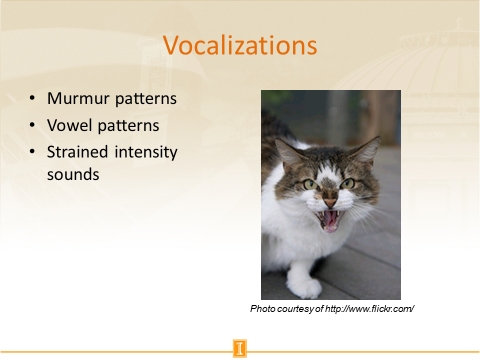
There are three types of vocalizations that we are going to look at: murmur patterns, vowel patterns, and strained intensity sounds. The most common murmur pattern is the purr. This occurs when kittens are only a few days old, and cats can also purr when they are severely injured. Another type of murmur is the feline trill. This is an acknowledgement pattern usually directed towards humans or another cat in their social group.
A vowel pattern is the meow. Usually this is when the cat's mouth is open and then closed. This can also be used as a greeting, anger wail, request for food or going outside. Cats rarely meow to each other, actually. The meow is typically directed towards human caretakers.
In terms of strained intensity sounds, this is usually a hiss, which is fear or anxiety related, or a shriek, which is when the cat is especially upset, possibly combined with a hiss and a spit.
The cat has a very wide range of body postures and facial expressions that are used to communicate with other cats and with their human caretakers. Most of these communication patterns are usually agonistic or distance displays—so distance-increasing or affiliative behaviors—distance-decreasing.
Once again, there's no dominance or submissive signaling in the cat. The cat had no reason to evolve these behaviors.
So the first posture we are going to look at is the offensive threat. A cat who is confident displays an offensive threat to make their body posture look larger. This is the very confident cat; basically "my territory—my stuff." In this photograph the orange cat is on the offensive and the black cat is on the defensive. So if you look at the orange cat, his ears are flattened halfway down. When a cat is on the offensive, his mouth is usually closed. This is a huge difference between offensive and defensive. The cat's body will be projected forward, and the back leg is usually extended and raised to full height. There might be a little bit of piloerection going on too. The cat will gaze directly at his opponent, and the pupils of the eyes will be constricted.
http://www.youtube.com/watch?v=t6LskvBdt6w
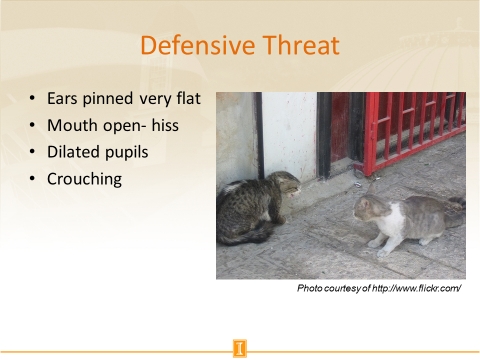
Looking at the defensive threat, usually the ears are pinned very flat, the mouth is open and in a hiss, the pupils are dilated, and the cat can even be crouching. This is a distance-increasing posture, and if you look at the picture below, the body of the cat is down. Usually these cats in a defensive posture are ready to escape or rollover. This is not submission. Usually when they rollover, they'll flip on their back and use their feet to scratch and bite. This is the posture that can also be seen in play as well.
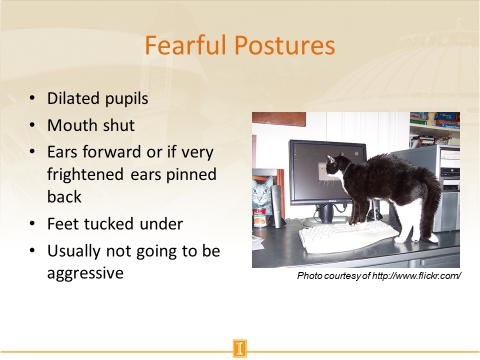
In terms of a fearful posture, a cat usually has dilated pupils and his mouth is shut. His ears are forward or very frightened ears are pinned back. Sometimes you'll even see the cat-cat's feet tucked under, front feet tucked under, and those that are fearful are usually not going to be aggressive. Some other fearful postures are the Halloween postures. This is actually a bluff pattern where the cat is just trying to look bigger but won't actually look at the opponent. This posture can also be seen in play, too. There's usually piloerection on the back and the tail can be inverted in a v-carriage. Usually they'll display this posture and then run or go into defensive aggression.
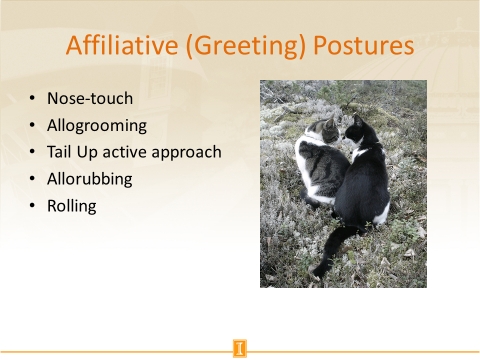
There are quite a few affiliative or greeting postures we're going to talk about. The first one is the nose touch. This is usually when the cat will touch nose with another species, such as a human, horses, dogs, etc. They usually touch their nose to them and then walk on. Allogrooming—some cats liked to be groomed; others don't. Typically cats will go back and forth, and this is definitely a greeting posture. Sometimes when they are grooming each other one of them will kind of get upset and make a rar noise, and this is actually usually the cat that got bit. The one that was getting groomed will give a little inhibited bite towards the groomer saying, "I'm done." So it's the one that was bit that makes the noise. This is quite normal. There is also something called petting-induced aggression. This is when a cat gets enough petting or grooming from humans, and that cat will all the sudden seem to get agitated, and these two behaviors are actually related—allogrooming and then the petting-induced aggression. Another affiliative or greeting posture is when the cat approaches with his tail up. This seems to be a behavior of domestication and is not seen in the progenerate species. And allorubbing is when the cat will start with the front of his face and then usually down the side of a body. This is usually affection. And lastly another affiliative or greeting posture is rolling, and this can be used to solicit attention or play.
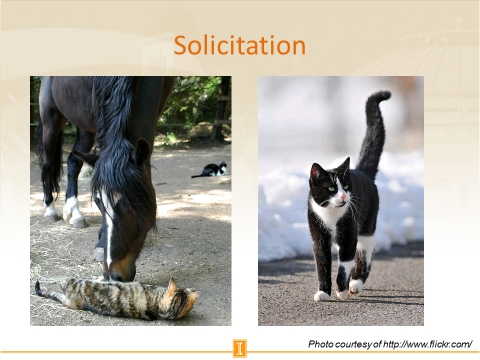
In these two pictures, these are examples of solicitation. They are distance-reducing postures. The cat on the left is rolling, as you can see, trying to solicit play, and the one on the right has the tail up approach. The ears of the cat are up and forward; the tail is up, the body is forward. They're willing to approach another person or animal, and then there may also be rubbing behavior. It is usually companion housecats that use the rolling to solicit petting or play.
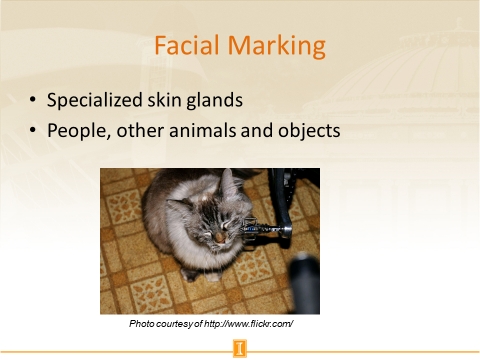
Cats have several types of specialized skin glands that are important for olfactory communication. These include the submandibular under the chin, the perioral glands at the corners of their mouth, the temporal glands, and the sebaceous glands along the base of their tail. The interdigital glands are located between the pads of the feet. When a cat rubs their face and head on objects the secretions of these glands are deposited as scent marks. The behavior of head rubbing on objects is called bunting. Many cats will direct head bunting towards their owner's legs and objects where the cat spends a lot of time, such as the couch, windowsill, and areas of entry and exit.