In this chapter we'll talk about one of the five components of health-related fitness: cardiorespiratory endurance. After this lesson, you should know the anatomy of the heart, and not only the structure of the heart, but know how blood flows through the heart and also how it moves through your body. You should understand the many different ways that we measure cardiorespiratory fitness, and also be able to apply the FITT formula that we talked about last week to design a program to improve your cardiorespiratory fitness.
When we talk about cardiorespiratory endurance, we're really talking about two main systems in the body, your cardiovascular system—or your heart and all the blood vessels and veins—and also your respiratory system and your lungs. When we talk about improved cardiorespiratory fitness, or someone who has greater cardiorespiratory fitness, imagine athletes, really great triathletes or long-distance runners or cyclists riding in the Tour de France. When you think about those athletes who have great cardiorespiratory fitness, they have more efficient oxygen delivery and consumption, meaning their heart can pump oxygen and deliver that oxygen to their working muscles more efficiently, and also their working muscles are able to consume that oxygen or use that oxygen more efficiently. This allows them to sustain continuous aerobic activity for longer periods of time. When we talk about those high-level athletes, the difference between those athletes and just amateur athletes or everyday people is that those athletes have the ability to sustain their aerobic activity at a much higher level.
So why do we care about cardiorespiratory fitness? Well, there are lots of reasons, but three big ones are that improvements in your cardiorespiratory fitness, greater levels of fitness, are associated with reductions in risk for chronic diseases, in particular heart diseases, but also other chronic diseases that we'll talk about later in this course, but also the improved quality and quantity of life.
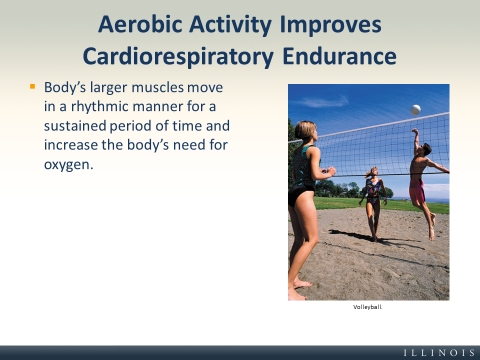
The best way to improve your cardiorespiratory endurance is to participate in aerobic activities, and here we're talking about using the body's larger muscles to move in a rhythmic manner for a sustained period of time and increase the body's need for oxygen, that's the definition of aerobic activities. Here we're talking about activities like biking, running, swimming, walking at a brisk pace. Sports such as soccer and basketball also have those aerobic components. And so remember, as your cardiorespiratory fitness increases, you'll be able to do these activities for longer or at a higher intensity.
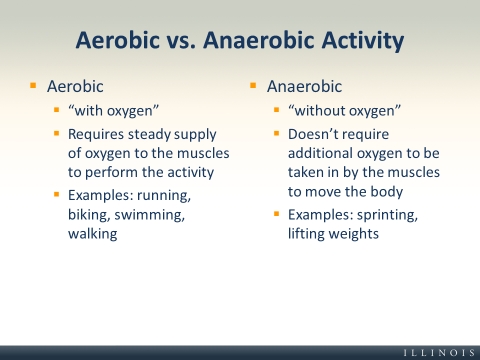
When we classify activities as either aerobic or anaerobic, we're really talking about the energy systems that are supplying the energy to the muscles needed to produce that movement, and so on the last slide we just talked about aerobic activity, and by aerobic we just mean "with oxygen," And here, the activity, to sustain the activity requires a steady supply of oxygen to the muscles. So examples, again, just like the last slide, running, biking, swimming, walking, all of those are great examples of aerobic activities that require that oxygen. The second type are anaerobic activities, and here we mean "without oxygen." That simply means talking about the energy system that does not require additional oxygen to be taken in by the muscles to move the body. So we're talking about very short bouts of physical activity, so sprinting, lifting weights are option 2 examples. The important key here is that most activities require the use of both systems, but are classified by the primary source of energy used for movement. So, for example, running, biking, swimming, are not necessarily solely fueled by this aerobic energy system, but instead that's the primary source of energy. So it's really both systems are at work constantly, but one source is primary over the other.
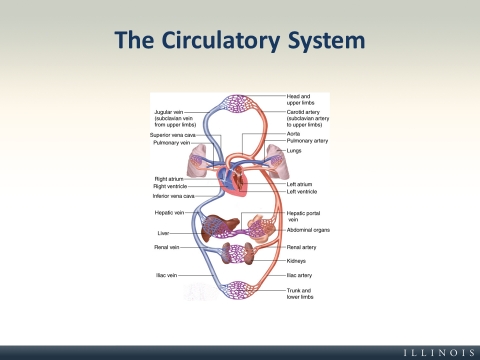
Pictured here on this slide you can see the entire circulatory system: the heart and the lungs, but also the arteries, the veins, and all of the tissues that are receiving nutrients from this, and oxygen in particular from the circulatory system. And so we're not going to talk a whole lot on this slide about it, but we'll talk about each of these components and how they're affected by improvements in your cardiorespiratory fitness on the next few slides.
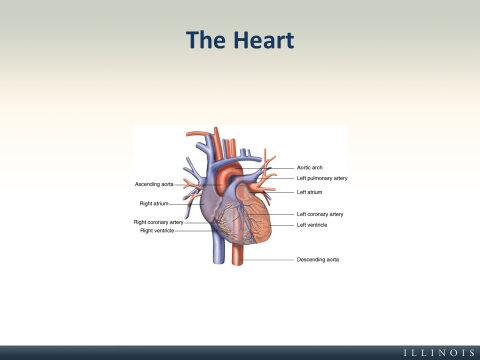
Here you see a picture of the heart, and you should be familiar with its basic anatomy for this course. It's an amazing organ that pumps blood through our bodies 24 hours a day, 7 days a week, without us ever having to think about it. Maintaining the health of your heart and the entire circulatory system is integral to leading a healthy lifestyle. Some basic anatomical structures of the heart that you should be familiar with, it has four chambers: both the right and left atria, which are at the top of the heart; the right and left ventricles, which are at the bottom of the heart—and these are, the right and left are oriented based on the heart being inside someone's chest, so it's opposite of what you see when you're looking at the screen here. There are also four valves, all of which are one-way to ensure that blood only moves through our heart in one direction. There's an electrical conduction system that allows the heart to beat without conscious thought. So unlike our skeletal muscles in our body that we'll talk about later in this course, this system is regulated by the sinoatrial node, or the SA node, and it's all autoregulated; we don't have to consciously think about making our heart beat. That SA node is also known as the pacemaker of the heart, and it's what keeps that regular rhythm of our heart. It's located in the right atrium, and there are many other important parts to this electrical system, but you're really only responsible in this course for that SA node. And I would encourage you to read the section titled "The Heart" in your textbook to familiarize yourself with the anatomy of the heart. This was a very brief introduction to those main components, but you should be able to label an entire picture of the heart here for this course.
Now that you're familiar with the anatomy of the heart, the structure and the components of the heart, we also need to understand how blood flows through the heart, how the blood moves through your heart and then out to the rest of your body. Watch this video, it's about 9 minutes long, but it clearly and slowly outlines the flow of blood through the body and through the heart as well.
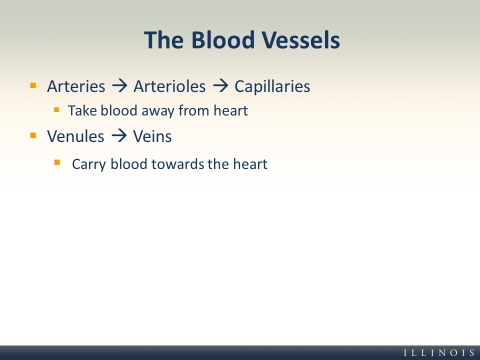
As you just learned from the previous video, when blood leaves the heart it travels in the blood vessels, and when blood returns to the heart, it also travels in blood vessels, and we have different names for these blood vessels. Blood that's moving away from the heart is carried in arteries, arterioles and capillaries, and as you can see in these slides here, arteries are the biggest, they get smaller into arterioles, and even smaller into capillaries, where the gasses, the O2, the CO2, can pass through the membranes of those capillaries. On the way back to the heart, blood's carried in venules, which are a little smaller than veins, and then taken back to the heart.
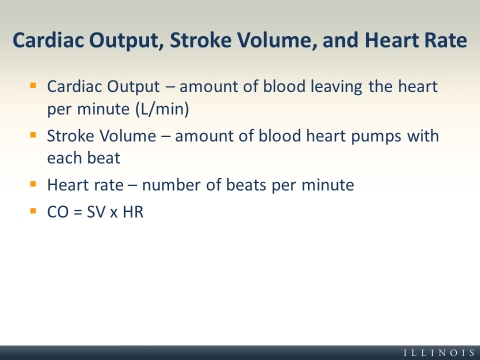
Now that we've talked about the structure of the heart and the cardiovascular system, let's talk about the functions of the heart that are affected by improvements in cardiorespiratory fitness. Cardiac output is simply the amount of blood leaving the heart per minute, that's measured in liters per minute, and it's the product of stroke volume—or the amount of blood your heart pumps with each beat—and heart rate, the number of beats per minute. So you see the equation there below, cardiac output equals stroke volume times heart rate. How much blood is leaving your heart every minute? That's what you get for your cardiac output. We'll talk about adaptations to these components with improved fitness in the next few slides.
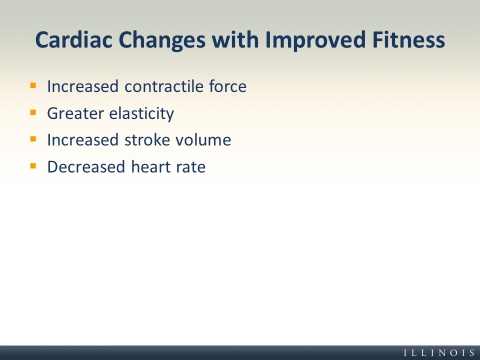
So when we have improved cardiorespiratory fitness, what happens to your heart? What are the changes in your heart that really drive that cardiorespiratory fitness improvement? The first is increased contractile force, so you're able to contract your heart with greater force, and again, that's not a voluntary contraction, but your heart is stronger, it's able to pump blood out with more force. Your heart is also better able to expand to let more blood in, which means—because more blood can flow in and you're able to contract with more force—you have an increased stroke volume. Additionally, a very fit person will have a lower heart rate than an unfit person when doing the same amount of work, and you could really think about this as your body becoming more efficient, your heart becoming more efficient in particular; more blood can be pumped out with fewer beats.
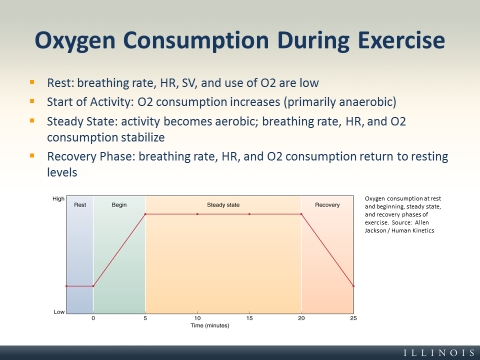
In this slide, you can see changes in oxygen consumption during an acute bout of exercise. So while we're walking through this figure here, I want you to imagine yourself going on a run or a bike or a swim. Pick some aerobic activity and imagine yourself going through these stages. So at the very beginning in the very left part of the picture, you can see the resting levels, and the red line you can imagine to be oxygen consumption. Resting levels of your oxygen consumption, your stroke volume, your heart rate, your breathing rate, all of those things are very low at rest. And then from 0 to 5 minutes, you can see in the figure the green-shaded portion or the part labeled "Begin." This portion is called your O2 deficit, or your oxygen deficit, and here you've just started your activity, your run, your swim, your bike, whatever you decided to think about. But there's more oxygen needed by your working muscles than can be supplied until your heart rate and blood pressure catch up with this initial start of activity. And in this period, this is where you see the connection between anaerobic and aerobic exercise. So although you're participating in an aerobic exercise, some of the energy that is being delivered to your muscles to fuel those muscles to do the movement that you are producing is delivered through those anaerobic energy systems here at the very beginning, and you can see that there's this pretty sharp increase in oxygen consumption, heart rate, breathing rate, all of those things initially. And then, from 5 to about 20 minutes during your aerobic activity, you reach steady state, and here the activity becomes truly aerobic. Your breathing rate, your heart rate, your oxygen consumption, all stabilize across this period. Now imagine that you stop running at 20 minutes. This recovery period, even though you've stopped running, your oxygen consumption remains above those resting levels; it doesn't immediately drop back down to resting levels in order to replenish the oxygen supply throughout your body. And so you can see here the changes in your oxygen consumption throughout an acute bout of exercise.
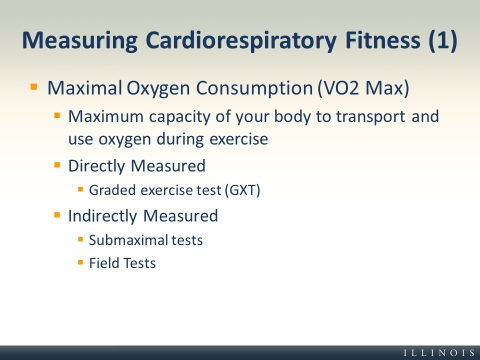
We spent the beginning of this lecture talking about the structure and function of the systems in our body that are associated with cardiorespiratory fitness, but now we're going to shift gears a little bit. In the last part of the lecture we'll talk about how we measure cardiorespiratory fitness, and then also how we design programs with the goal of improving cardiorespiratory fitness. When we talk about measuring cardiorespiratory fitness, we're really talking about measuring maximal oxygen consumption, or VO2 max, for short, and this is the maximum capacity of your body to transport and use oxygen during exercise. So how well does your body move oxygen to the tissues that need it, in particular the working muscles, and how well do those muscles use that oxygen when you're exercising? And so that's really what the maximal oxygen consumption, or VO2 max, is all about. Now we can either directly measure this through a graded exercise test—and we'll talk about what that is on the next page—or we can indirectly measure maximal oxygen consumption through either submaximal tests or some field tests, and again, we'll talk about those on the next few slides as well.
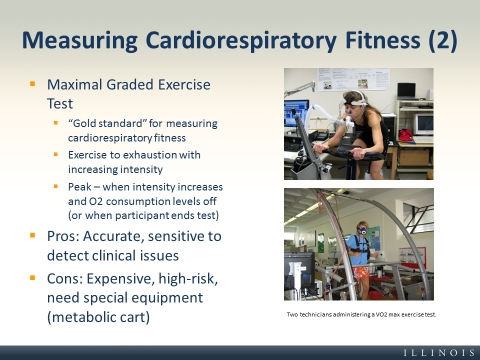
Oftentimes what you'll see is that direct measures of cardiorespiratory fitness, or VO2 max, are difficult to administer, expensive, time consuming, they require special equipment, and so because of that, many of these indirectly measured tests have been developed. Maximal graded exercise tests allow us to measure cardiorespiratory fitness or VO2 max directly, and these tests are really the gold standard, or the best way for measuring cardiorespiratory fitness. As you can see from the two pictures, there are multiple different ways that you can conduct this test. The picture on the top shows a young woman connected to a metabolic cart that's collecting all of her expired air, but she's on a cycle ergometer. The woman on the bottom is running on a treadmill, again connected through a very similar system that's collecting her expired air. Regardless of the type of activity that you use here, this test requires the person to work to exhaustion while the test is continuously increasing intensity, and the peak of the test, or the end of the test to determine cardiorespiratory fitness, or VO2 max, is when the intensity increases—so, for example, on the treadmill, you could increase intensity by increasing speed and/or the incline, usually both—when that intensity increases and the consumption of oxygen from the person levels off, or alternatively the participant always has the option of ending the test when they feel they can no longer go any further. So the good things about this test are that it's accurate, it's sensitive enough to detect clinical issues—so, for example, these tests are sometimes used to detect coronary artery disease in individuals who are asymptomatic who don't present with any symptoms at all. The cons are that it can be very expensive, potentially high-risk because you're taking people to maximal state of exercise, and you need special equipment like the metabolic carts that are featured here in the pictures.
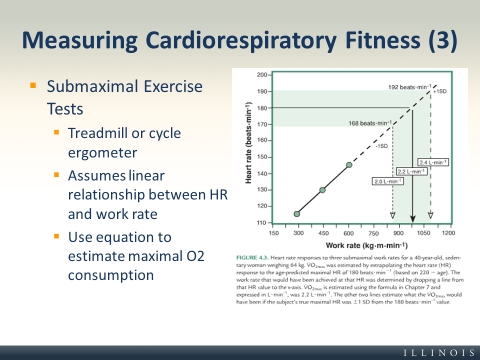
To overcome some of the cons of directly measuring VO2 max through a graded exercise test, sometimes we use submaximal exercise tests to indirectly measure VO2 max. Again, these tests would require a very similar set up with a metabolic cart, the person breathing in and out through a tube connected to that cart. They could be using a treadmill or a cycle ergometer for this test, and what this test really does is takes a person to, for example, maybe a predetermined heart rate, some level that is below their maximum level of effort, and then assumes a linear relationship between the person's heart rate and their work rate. So you can see in the figure on the right, you have heart rate on the y-axis, work rate on the x-axis, and the first three points that are connected by solid lines are points that were derived from someone's actual data on a submaximal exercise test. The rest of that line is dotted because it's an extrapolated line, assuming that the relationship is going to stay the same as that work rate increases. And it's essentially using an equation to estimate what someone's maximal oxygen consumption would be, without having to take the person to a maximal effort or exertion.
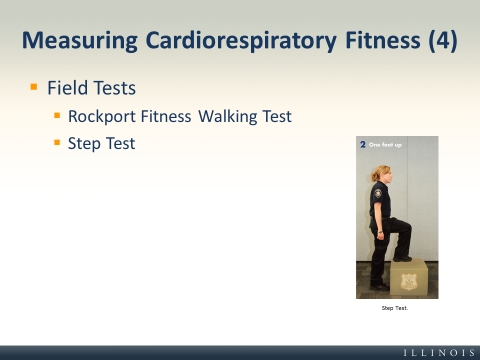
The second way we can indirectly measure VO2 max is through some kind of field test. Here two examples given are the Rockport Fitness Walking Test and also the step test. The Rockport Walking Test asks a person to walk 1 mile as fast as they can, and then immediately measures the heart rate, either manually or with a heart rate monitor, and then you can use equations and charts to try and predict someone's VO2 max based on their results from that 1 mile walking as fast as they can. The second example is a step test. Here you ask the participant to step onto a raised platform at a given cadence for a set period of time, usually about 3 minutes, there are different protocols, but usually about 3 minutes, and then VO2 max is estimated from the person's heart rate recovery, how quickly their heart rate recovers after this test that's done at a particular cadence. Both of these are examples of tests that can be done with very little equipment, they mimic daily activities like walking and stepping, they're very inexpensive, they're easy to administer, so they have lots of pros. But they are indirect measures of cardiorespiratory fitness, so they're not the best measures, but they certainly can give you an idea of cardiorespiratory fitness if you have very little equipment, they're easy to administer, and so they do have some benefits as well.
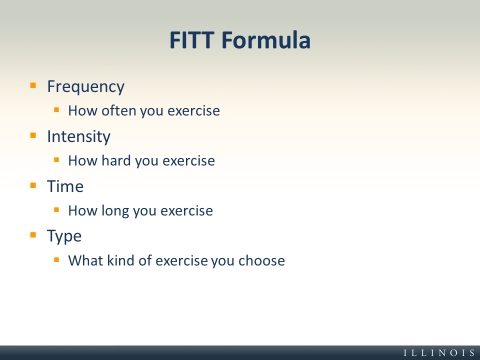
In the final few slides we'll talk about using the FITT formula, which stands for Frequency Intensity Time and Type, talk about how we use this FITT formula to develop a cardiorespiratory fitness training program or exercise program that really has the goal of improving cardiorespiratory fitness. And so we'll talk about how often you should do aerobic activity, how intense that activity should be or how hard you should be working, how long each session should be, and then also what types of activities you should choose.
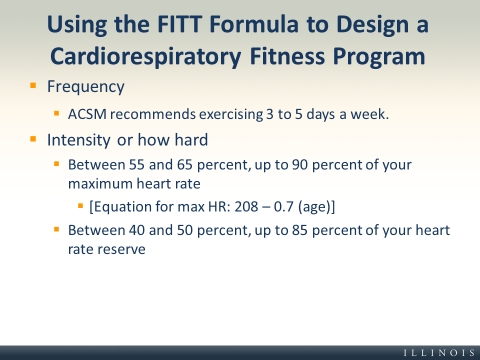
The American College of Sports Medicine, or ACSM, recommends exercising 3-5 days per week, aerobically, that's aerobic activity 3-5 days per week, to see improvements in cardiorespiratory fitness. They recommend that this aerobic activity be between 55 and 65%, all the way up to 90% of your maximum heart rate, that's the first method of kind of gauging your intensity, and the equation for your max heart rate is provided here. The second method would be to exercise between 40 and 50% or all the way up to 85% of your heart rate reserve, and as you probably read in your book, your heart rate reserve is simply the difference between your maximum heart rate and your resting heart rate. So that's why those values are a little bit lower. In both cases, exercising below that 55-65% of your max heart rate or 40-50% of your heart rate reserve, you might not see the same cardiorespiratory fitness benefits that you would if you exercise above that percentage. If you exercise above the recommended 90% of your maximum heart rate or 85% of your heart rate reserve, you're likely targeting some anaerobic systems and not necessarily your aerobic systems that really help develop your cardiorespiratory fitness.
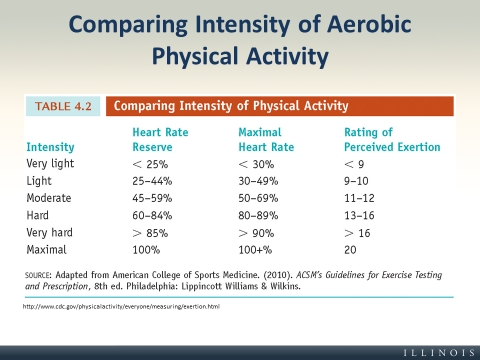
The chart picture on this slide compares the multiple ways of measuring intensity that we talked about on the previous slide, heart rate reserve and max heart rate, and you can see here that they're also connected, those different categories are connected to intensity descriptors such as very light, light, moderate, all the way up through maximal exercise. This chart also shows how these percentages of heart rate reserve and max heart rate correspond to the Rating of Perceived Exertion scale. This scale is a subjective measure, it allows the participant to rate how hard they're exercising while they're exercising. So it typically ranges from 6 to 20, the original scale does, and it's correlated to the actual, the person's actual heart rate during exercise. It's a very widely-used measure that assesses the person's perception of effort. There's a link at the bottom of the slide here, and I'd like you to click on that link and read all about the Rating of Perceived Exertion scale. There's also some more information in your book about the original and also an adapted version of the Rating of Perceived Exertion scale.
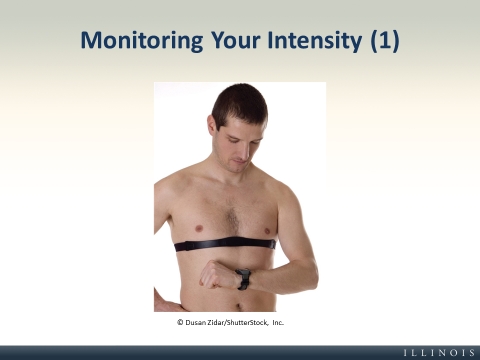
You can see in this picture that a gentleman is wearing a heart rate monitor around his chest, that he's checking his heart rate on the watch that's on his wrist. Measuring your heart rate while you're working out, or while you're engaging in an aerobic activity, is a great way to gauge the intensity of that exercise, and these digital electronic heart rate monitors really help you to do that pretty accurately.
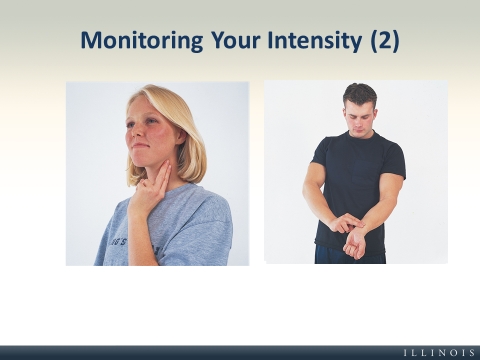
The two pictures on this slide show two people palpating places on their body to measure heart rate manually. So on the left you see the woman palpating her carotid artery, and on the right the gentleman is palpating his radial artery, both to get measures of their heart rate. The challenge with manual heart rates is that your heart rate is dropping dramatically as you stop exercising, so it's difficult to get as accurate of a reading when you're using your manual heart rate compared with the electronic on the previous slide, and also it's pretty hard to do this while you're working out. So oftentimes you have to stop exercising in order to take your manual heart rate, but still a great way to gauge the intensity of your exercise efforts.
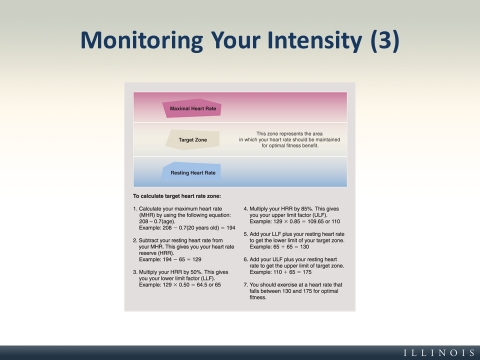
Because using your heart rate to gauge intensity is one of the most common ways to gauge intensity of a cardiorespiratory exercise program, you should know how to calculate your target heart rate for exercising at a particular percentage of either your maximal or your heart rate reserve. And so we won't discuss this a whole lot here, but make sure you look at page 68 in your textbook, and know how to calculate a target heart rate based on a maximal and resting heart rate.
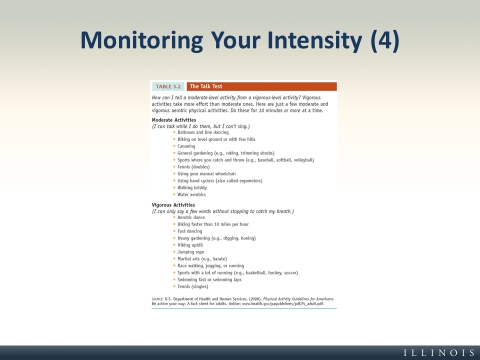
Another very simple way of determining the difference between a moderate and a vigorous activity is the talk test. If you can talk and sing easily while doing the activity, then you're doing an activity that would be considered pretty light. If you can talk but you'd have trouble singing, then you're likely doing a moderate-intensity activity, and if you can only say a few words before needing to catch your breath, then you're probably engaging in a vigorous form of physical activity.
As you remember, the third component of the FITT formula is time, or the duration of a particular exercise session, and here we recommend that an exercise session lasts for 20 to 60 minutes in order to gain significant aerobic benefits. The key here is that it doesn't all have to happen at the same time, so you can accumulate bouts of exercise over the course of the day, as long as those bouts are at least 10 minutes long each. And there is a give and take with intensity and duration when you're talking about developing cardiorespiratory fitness. So, for example, if you exercise at a much lower intensity, so let's say closer to the 55-65%, then you'll need to be active for a little bit longer during your exercise sessions, as compared to if you were exercising at 80% of your maximal heart rate. Then you could be active for maybe closer to the 20 minutes that is on the low end of the time or duration aspect here. The final component of the FITT formula is the type of activity you choose, and here you'll want to refer back to the very beginning of the lecture, and choose some of those activities we talked about that use your larger muscle groups—so your quadriceps, your hamstrings—and is rhythmic in nature. So here, again, examples could be swimming, running, biking, all of those are great aerobic activities.

Finally, one of the most important things is that you choose an activity you enjoy. If you choose something you enjoy, that's the activity that's going to work best for you. And so there's not one form of physical activity or aerobic activity that is the absolute best. The best one is really the one that gets you out there and gets you to do the activity and work towards improving your cardiorespiratory fitness.