Okay this is the pre-recorded session for week 3. In particular, building internally consistent compensation systems, please refer to chapter. In the way of overview for weeks 3 and 4 we will be considering the building blocks. Compensation system design. These are the fundamental structural elements that you will see in most compensation systems across a variety of organizations. There are three structural elements that we will consider this week and next week, that is week 4. This week we will consider building internally consistent compensation systems. Then we will look at building market competitive compensation systems.
Next week, week 4, we will continue, if needed, with building market competitive compensation systems and then we will look at the third element and that is building pay structures that recognize employee contributions. Also in the way of overview, these structural elements in the order in which we will consider them, is based on logic. Building pay structures that recognize employee contributions does depend in large part on what we accomplish in building market competitive compensation systems. And being able to build market competitive compensation systems does depend upon what we achieve in building internally consistent compensations.
Now, through the years, students have often asked me whether they will encounter compensation systems in the manner in which we will discuss them this week and next week, that is will they actually be developing the structural elements and I tell them it depends if you're going into a relatively new organization that’s small yet growing. You could be leading the development of these elements but in more cases than not, students, and you as most of you are currently working, already see compensation systems that have been developed well. So you won't be going through the process of building, but you'll be in the process of implementation and evaluation. By understanding how the structural elements unfold and the logical sequence of these, you will be in a very good position to work with existing compensation systems and to modify them as necessary. And finally in the way of overview, when we talk about building internally consistent compensation systems and building market competitive compensation systems, we are referring to jobs as the primary unit. At this point in designing the system, we are not considering employees in jobs. It isn't until we get to building pay structures that recognize employee contributions, that we will break job applicants and employees into the discussion and I think you'll see how that unfolds in this week and next week, week 4.
Now let's turn to building internally consistent compensation systems. In chapter 6 we have 5 learning objectives to address. The first learning objective is to explain the concept of internal consistency. The second objective is to summarize the practice of job analysis. The third objective is to describe the practice of job evaluation. The fourth objective is to summarize the various job evaluation techniques. And the fifth objective is to explain how internally consistent compensation systems and competitive strategy relate to each other.
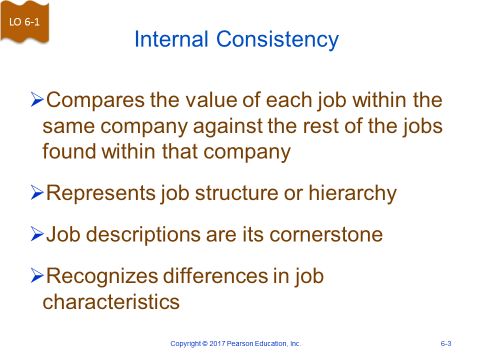
The material for the first learning objective can be found on slides 3 through 6. So let’s start off with a definition or description of what we mean by internally consistent compensation systems. Internal consistency compares the value of each job within the same company against the rest of the jobs found within that company. So this is an internal comparison of jobs. This approach leads us to develop the job structure or hierarchy based on the comparison of jobs against each other within the company. Job descriptions are the cornerstone of developing job structures and we have to recognize differences in job characteristics. So when we talk about job descriptions as the cornerstone, this points to one activity that we’ll talk about and that's job analysis.
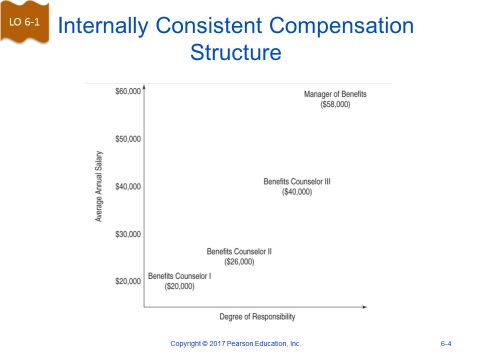
And the second, recognizing differences in job characteristics points us to job evaluation. Well you can visualize what a job structure looks like and an illustration of what we mean by internal consistency by looking at what is in slide 6-4. What we have here is a job structure for benefits professionals and we can see that the axle horizontal axis represents a characteristic of this job and many jobs for that matter and that's degree of responsibility. Moving from left to right we can see increasing degrees or levels of responsibility. The vertical axis shows us the Annual pay rates for these jobs. Now for internal consistency our interest is mainly with the horizontal axis and what we're doing is to get to an internally consistent job structure is we start by describing the work through job analysis. And therefore we will have job descriptions for each of the jobs listed on slide 6-4. And then with job evaluation we will compare each job against the others in terms of degree of responsibility, and we do it against other factors as well, such as knowledge, skills and ability, but this is just to make the illustration as simple and straightforward as possible. So we use job analysis to describe the jobs which allows us to drop them into this figure. And then job evaluation allows us to rank them in terms of differences in job characteristics. In this figure you can see the salaries. And this is important but this comes into play later in the development of compensation systems and that is when we get to market competitive systems but I just wanted to show you a fuller picture of what ultimately we’ll call pay structure but again ignoring the vertical axis and just looking at the horizontal axis, that's what gives us and shows us internal consistency.
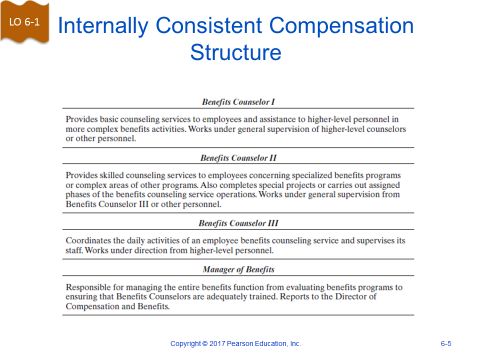
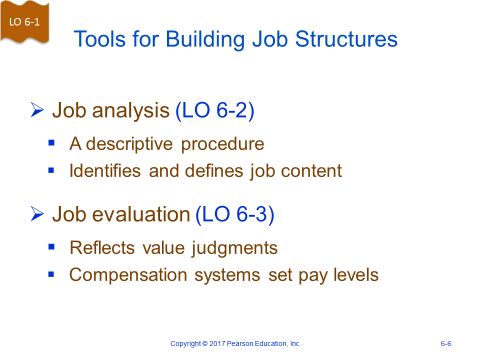
On slide 6-5 I've included some very brief job descriptions for each of the benefits counselor jobs and then the manager benefits job that appear in slide 6-4. And they characterize the differences in degree of responsibility. So we built internally consistent job structures by relying on two practices. The first is job analysis which comes under learning objectives 6-2. And job evaluation which comes under learning objective 6-3. For job analysis this is the descriptive procedure that identifies and defines job content. The outcome of the job analysis process is the job description. So let me emphasize, descriptive and description. Job analysis does not really bring in judgment or actually should not and does not bring in judgment about the relative worth of jobs to the company. It's simply defining the building blocks that we will use as a basis for conducting job evaluation. There we're using value judgments to look at and determine the relative difference of jobs within the company.
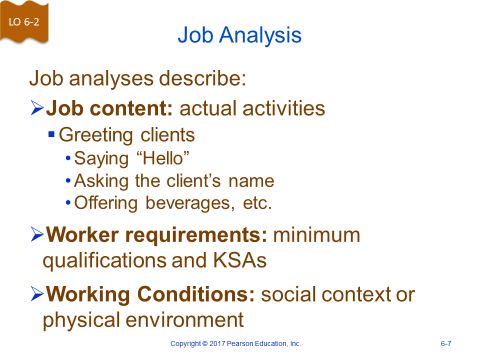
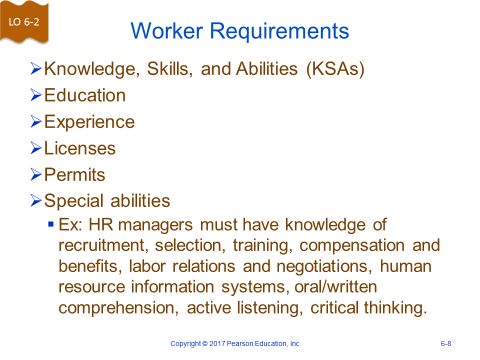
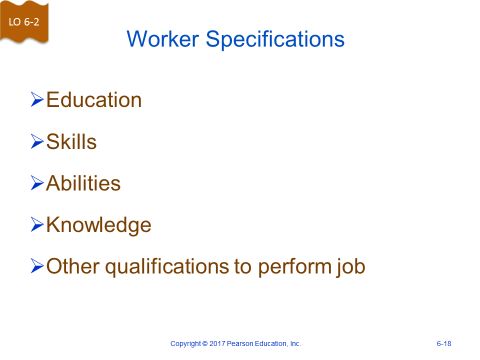
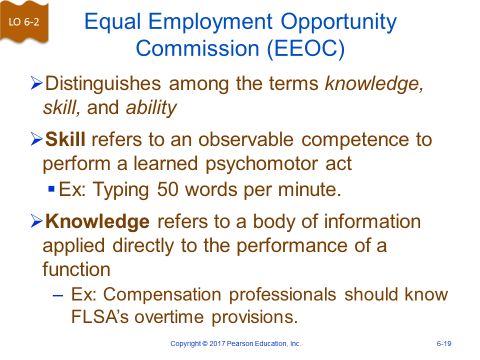
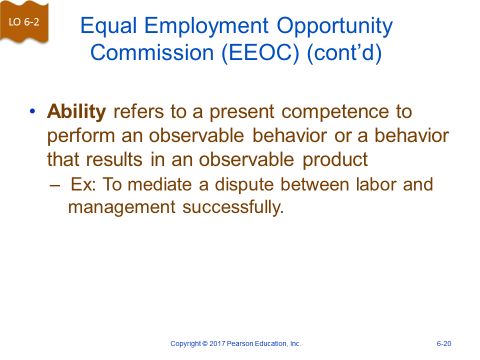
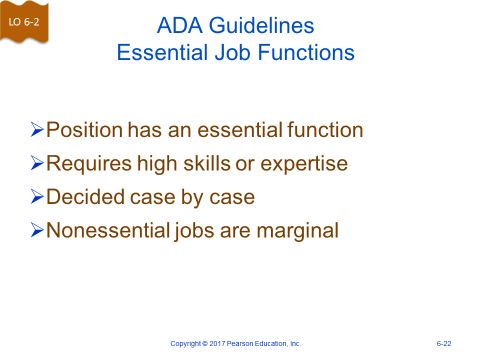
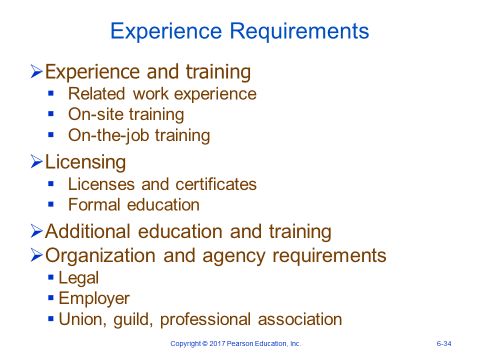
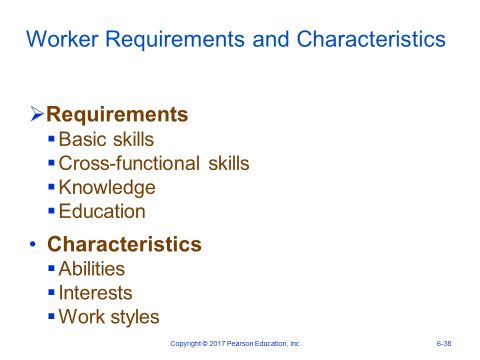
Let’s turn to the second learning objective which is job analysis. This information can be found on slides 7 through 22. As we move through this learning objective I will then take us to an appendix that I've created for the second learning objective and that's about Onet, but more to come on that in just a bit. So job analysis when we talk about describing work, we are breaking, we are trying to describe a variety of information. Job content is the first. So these are actual job activities. So in the case of a receptionist, greeting clients, saying hello and so forth. The second type of information that we're working with and describing are worker requirements. Worker requirements refer to minimum qualifications and KSA’s, that is knowledge, skills and abilities. And then the third type of information we're working to describe is the working condition variable. And working conditions refer to social context or physical environment. So we can look at worker requirements now and talk about this starting with knowledge, skills and abilities. Also factored in is education experience, any licensing that is required to perform the work, special abilities for example HR managers must have knowledge of the recruitment selection training compensation and benefits labor relations in negotiations, HR information systems and so forth. Also those are a combination of abilities that help to distinguish HR managers from other jobs.
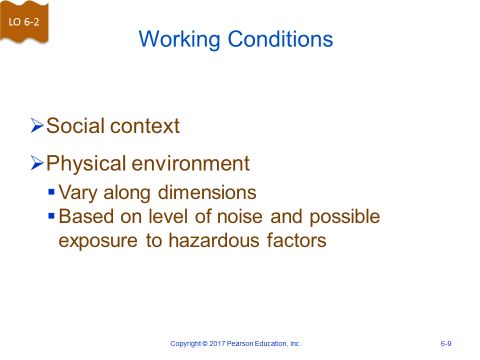
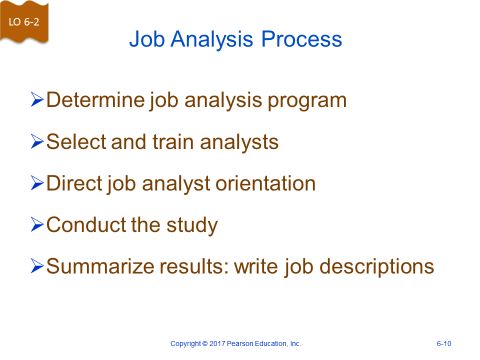
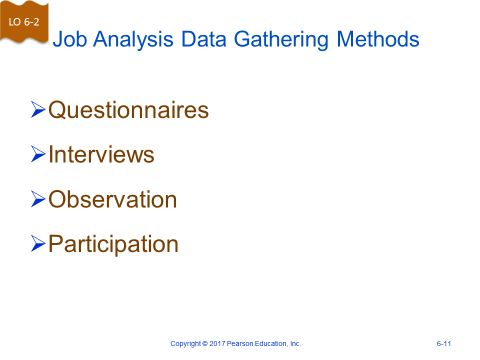
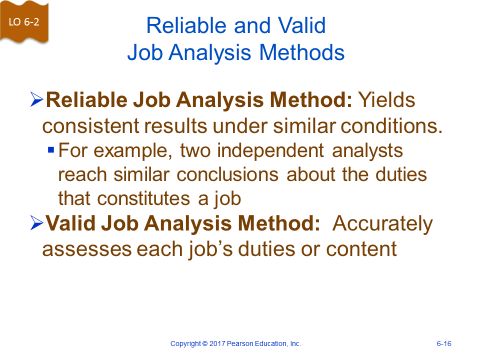
Working conditions focus on social context and physical environment. For social content this is where looking at interpersonal relationships, interdependence we're considering, so we might call those horizontal types of aspects and then vertical aspects would be things such as supervisory responsibility that creates that social context for working condition. Physical environment will vary along different dimensions such as the level of noise and possible exposure to hazardous factors. In many organizations today, in service oriented organizations and professional offices, we really don't see much variation on working conditions but when we talk about people working out in the field for example, people who are climbing a cell towers to repair them. Or people working with heavy equipment in a manufacturing facility or somebody who is working with chemicals in the chemical processing plant, these are where we can find important elements of the physical environment that we need to take account of for describing work. For many decades when we refer to the job analysis process, we typically discussed a set of sequenced activities, starting with determining the job analysis program, selecting and training analysts through summarizing results and writing job descriptions. Again that fundamental element or one of the fundamental elements in creating internally consistent job structures. You can review the slides for the rest of this learning objective and it will more or less take you through that job analysis process and it's a very logical one.
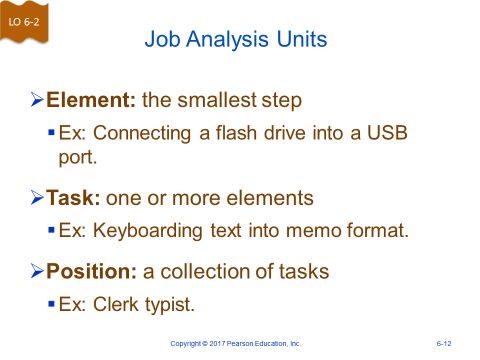
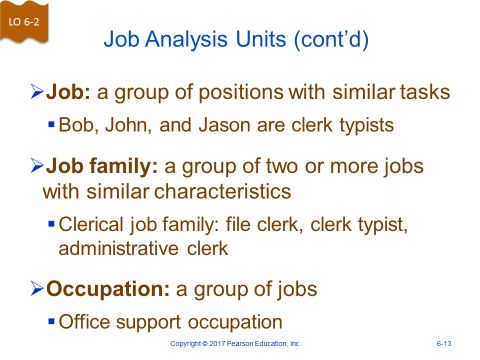
Let me point out one slide or two slides, slides 12 and 13, that describe the job analysis units. Starting with the smallest or most micro, such as an element, and moving through broader characteristics or units such as a job which is a group of positions within similar tasks, all the way up to the broadest which is an occupation, a group of jobs. These are the technical language that goes along with job analysis. The traditional approach to job analysis is highly structured and when done correctly it really produces well-defined jobs that help us to make decisions later about employee status and certainly for our purposes, to build an internally consistent job structure. We need to rely on experts who have been trained in conducting job analysis, to perform this. And those individuals are trained n industrial organizational psychology at the masters or PhD levels. There are many consulting firms out there that specialize in job analysis. They're very expensive but they give you what you need. A lot of companies tend to shy away from doing traditional job analysis because their job structures change rapidly as business pressures and opportunities change. And they feel like in a very short period of time, the job structures that have been created and the job descriptions themselves may not be perfectly accurate anymore. And there's been a lot of time and expense that has gone into something that may be increasingly less relevant.
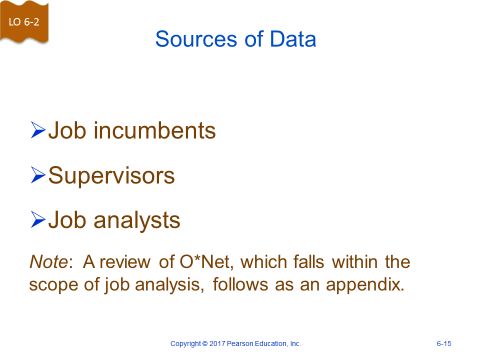
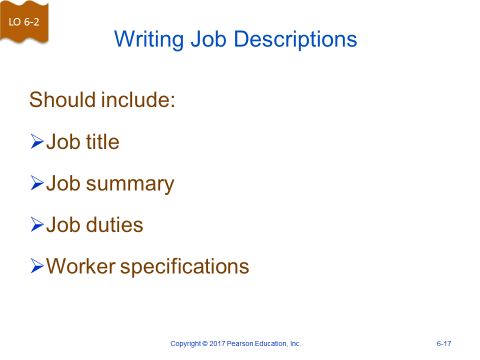
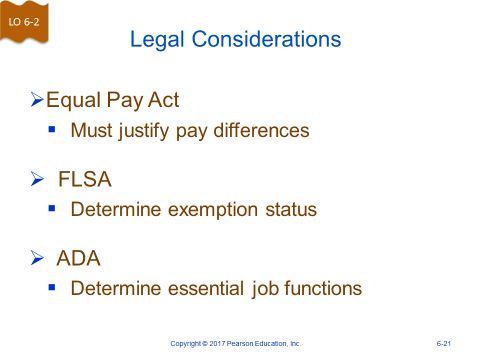
Job analysis is an important activity for the reasons we’re describing here in building compensation systems. But also it's a very helpful technique having done it and written job descriptions that's based on a reliable and valid job analysis technique, can help a company defend itself against claims of illegal discrimination. In general courts will look to what is the job description and how were they derived. Keep in mind while a useful process, job analysis is not a requirement by the federal or state governments. On slides 17 and 18, you can see the basic organization of sections in job descriptions. And nowadays there are so many resources available online that help companies write job descriptions and those are excellent are as well. But as an alternative to the traditional job analysis process, we can take advantage of something called the Occupational Information Network or ONet. ONet is the result of years of collaboration among the Occupational information network or own that. O. net is the result of years of collaboration among the federal government, academic researchers and practitioners like yourself. It's a database that is constantly being updated to capture what is typical jobs and occupational groupings in the US economy. This is a good point for looking at the appendix which starts on slide 31.
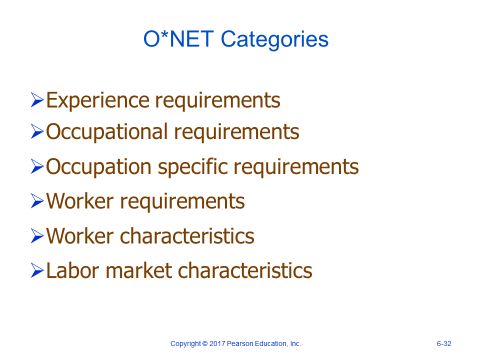
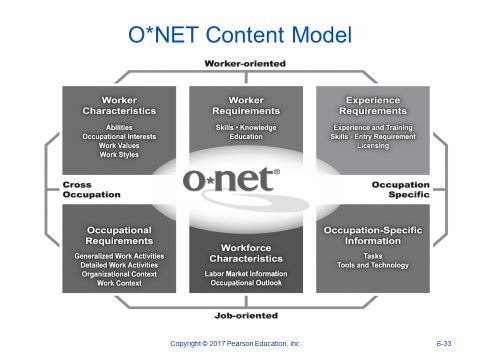
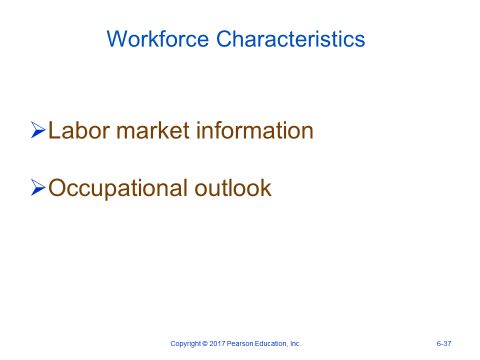
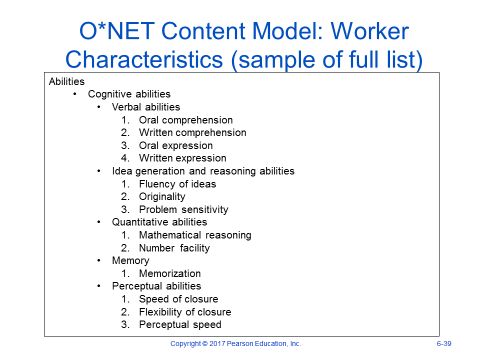
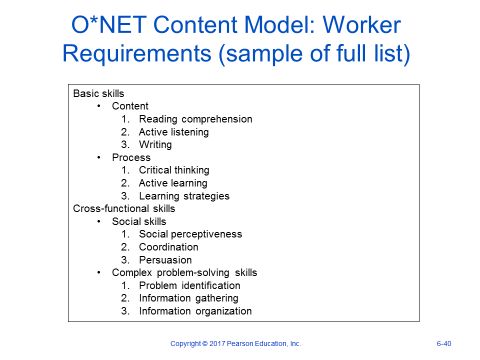
If when you get there look at slide 33. This is the ONet content model. Look at the outer band of this content model and you will see 6 categories starting at the top ad then we'll move toward the right until we come full circle. We start with worker oriented information. And you could see that there are 3 types of worker information. Within each type you will see particular examples. Moving on we have occupational specific characteristics. As we continue up moving, we come to job oriented characteristics such as occupational requirements in workforce characteristics. And the last part of this, we're looking at cross occupational characteristics, that is characteristics that we could see spanned across occupational groups. Onet is wonderful resource and I know that I've mentioned this in an earlier pre-recorded session. You should take advantage of this resource because of its relevance, it's free, and especially if your company is not one that is investing in traditional job analysis activities. The textbook indicates the link to ONet. And it is onetonline.org where onetonline is one word. Unfortunately, with the system we use to conduct online classes I am unable to easily take you there for us to look at examples together and I apologize for that. But when you have a chance and hopefully before the next live session, you can go through some of the examples in ONet. They will generate job descriptions for you that are in extensive detail. In the content model you see all of these variables. You will find an extensive detailed job description based on each and every factor that you see in the ONet content model. And that's probably a lot more information than you need. There are other uses for ONet and that's why you might see things like worker values.
When you are in onet and you've selected a job and you have all of the information for the job, you can prepare a custom job description. To do that you will select the factors that you were interested in including. And then you could go so far as to limit the number of items within each factor based on importance ratings that have come up through the collaboration that I discussed earlier. otherwise you might find15 or 20 task statements and that may be more than you need and as you move down the line there may be ones that are just peripheral. ONet will do a great job telling you what the core characteristics are. So when you can, take a look at ONet. and generate some job descriptions of interest and go through it and generate custom reports for yourself and try different parameters to see what you get. I think you will find this useful. Now not to say that ONet is there to write the final job descriptions for you, but it's a great way when you're trying to define work for new positions or jobs and trying to make revisions to existing jobs, ONet becomes a great source of information.
To summarize learning objective two, we've been interested in describing job analysis and job analysis techniques. At the beginning of the pre-recorded session, I indicated that our goal is to create internally consistent job structures. In that there were 2 activities. Job analysis which is a descriptive process and then job evaluation which is a judgment process. We are now going to turn our attention to job evaluation. That information can be found on slides 23 through 25.
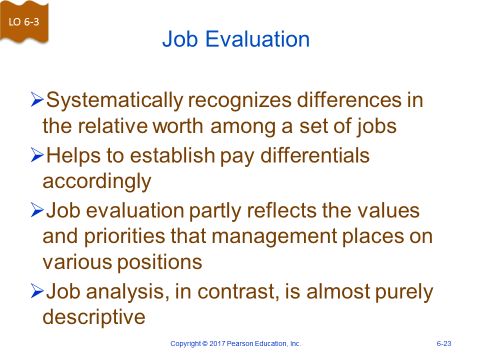
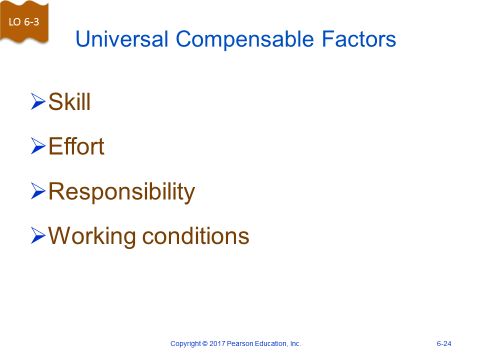
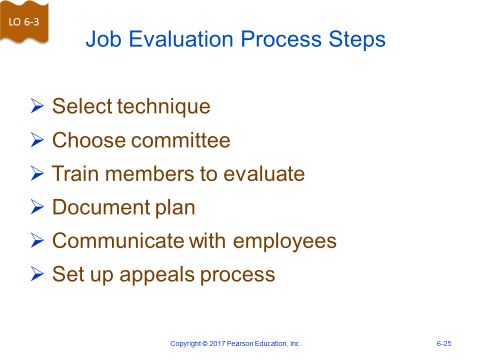
Job evaluation systematically recognizes differences in the relative worth among a set of jobs. These evaluations help us to establish pay differentials accordingly. Often times job evaluation and may reflect impart the values and priorities that management places on various jobs. When we talk about establishing the relative worth of jobs, we consider compensable factors. Now compensable factors is a term used in compensation, and refers to skill, effort, responsibility and working conditions. Or in modern times, to the factors that we see in the job content model, put forth by ONet. Differences in levels of skill, effort, responsibility and working conditions helps us to set pay differences between and among jobs that vary on these dimensions. But again we will probably use ONet and the compensable factors that are described there because they're more representative of the complexity of work today. But it's important just to emphasize that on slide 24 the universal compensable factors were generated out of the Equal Pay Act of 1963. That is, it's illegal to pay women less than men for performing equal work. And there are some exceptions to that but that's in general, it's a legal to pay women less than men for performing equal work. The courts decided that the definition of equal work would be based on four factors and those are skill, effort, responsibility, and working conditions. And those represent the foundation elements for making determinations of possible violations of the Equal Pay Act. The fundamental steps in job evaluation are described on slide 25. These steps are more representative of what companies actually do when planning for and conducting job evaluation.
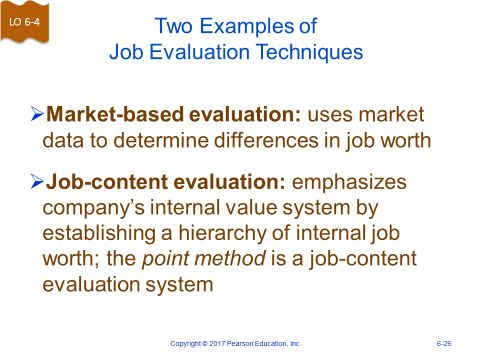
For learning objective 6-4, slide 26 through 29 contain that information. There are two broad approaches to job evaluation. The first is a market based evaluation, chooses market data to determine differences in job worth. So that means going out and conducting salary surveys and using that as a basis t0 determine differences in the relative worth of jobs in the metric of dollars. We will look at this when we discuss market competitive pay systems in the next pre-recorded session. However, what we're doing here initially is taking on the job content valuation approach. This approach emphasizes companies internal value systems by creating a hierarchy of internal job worth.
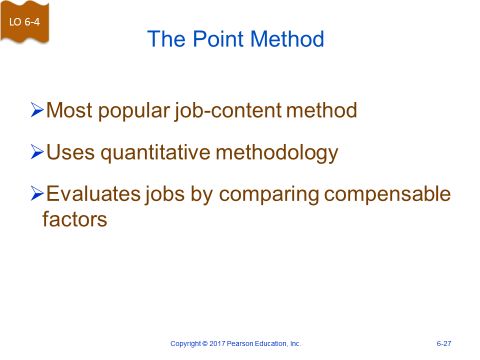
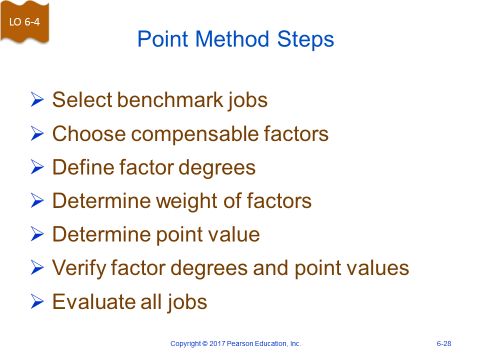
One of the most common techniques for evaluating jobs is the point method. Slides 27 and 28 provide a broad overview of the point method system. Please refer to the text book for a detailed step by step discussion of how you build, implement and evaluate a point method system. There are also exhibits to illustrate the outcome of each step along the way. It's simply not feasible for me to run through those steps in detail in a pre-recorded session. Given the complexity of that work, it's much more feasible to have you read this in the textbook and please remember that the way this is written represents my experience with this technique through the years. If we were to meet face to face, I would be working with you to go through the steps and actually build a sample job evaluation system, but that's simply and unfortunately doesn't lend itself well to the online format. Naturally, after you read the material if you have any question, please do feel free to ask me. What I can say about the point method system is it's the most detailed approach for evaluating jobs based on that job content message. It allows us to break down all of the compensable factors into degrees and we are able to use a point system to rate each and every job. And at the end of the process of comparing each and every job against every compensable factor. We will have a system that will tell us the relative worth of jobs based on differences and content. It isn't until we get to market competitive pay systems that we bring in the external market and start to assign pay rates to these jobs. The goal was for us to assign pay rates based on the market that correspond to differences in job structure.
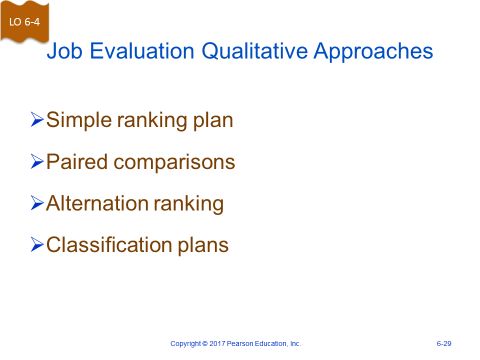
There are alternative job evaluation techniques that help us to judge the relative difference in jobs. These are qualitative approaches because we do not introduce any numerical system to help capture the differences in value between jobs. These plans are listed on slide 29 and are described in the textbook. The simple ranking plan for example requires that an individual take a set of jobs and to rank them a based on some set of criteria. It's not as detailed and actually it's for being far from detailed as the point method system because we are making the ranking more or less on global impressions of the jobs relative to each other. And by looking at the global impressions, we're certainly missing the fine elements that make up our jobs and help us to establish differences between jobs. I also think if a job evaluation system is ever challenged in a court of law, or even if employees are asking HR to explain the job evaluation system plans like the simple ranking system, simply don't hold up very well. It's hard to explain the global judgments that individuals have used to rank jobs.
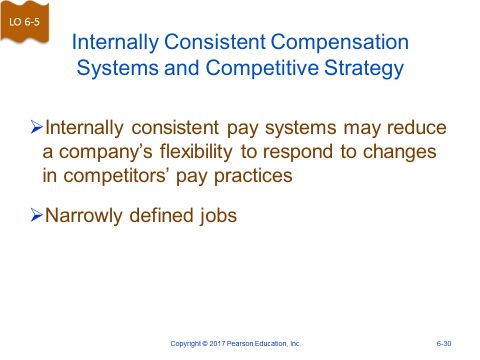
And finally we have wording objective number 6 which is stated on slide 30. This is internally consistent compensation systems and competitive strategy. One of the concerns about establishing job structures is possible inflexibility that it creates for companies. If we follow the structure starting with job descriptions, it gives management relatively little flexibility and having workers do other kinds of activities not described in those documents. When we get to pay structure development you'll see that there will be pay ranges for groups of similar jobs. There's flexibility that comes as a result of very well specified job structures in terms of limits to pay. If you have an exceptional employee who has done amazing work over a period of time, it's possible that they will hit the top of their pay range and there's inflexibility if the company truly wants to stay in line with that system and limits the ability to pay that employee more. We also have to be careful with developing internally consistent job structures by not narrowly defining jobs. If you were to look at job descriptions in the union setting you will find them very narrowly defined in terms of tasks, duties and responsibilities and according to collective bargaining agreements, it is it really possible for management to have employees work outside the scope. In a nonunion setting, if a company has similar narrow job descriptions, and that does happen from time to time, they could find themselves experiencing constraints and being able to flexibly deploy individuals to take on other assignments.


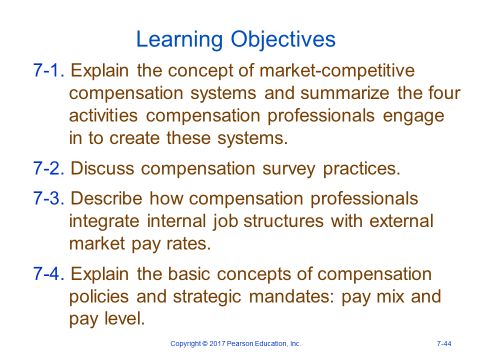
Okay so we have covered internally consistent job structures and will now turn to chapter 7 which is Building Market Competitive Compensation Systems. There are four objectives that we will address regarding this topic. The first is to explain the concept of market competitive compensation systems and summarize the four activities that compensation professionals engage and to create the systems. Second, we'll discuss compensation survey practices. Third, we’ll describe how compensation professionals integrate internal job structures with external market pay rates. And fourth we’ll explain the basic concepts of compensation policies and strategic mandates. That is will be looking at pay mix and pay level.
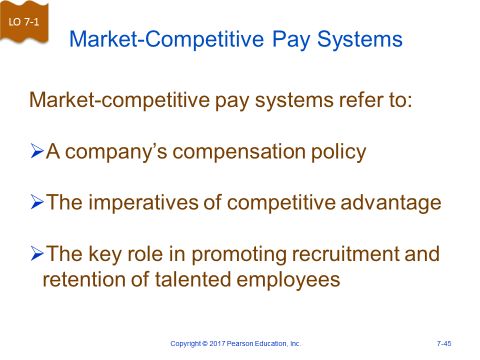
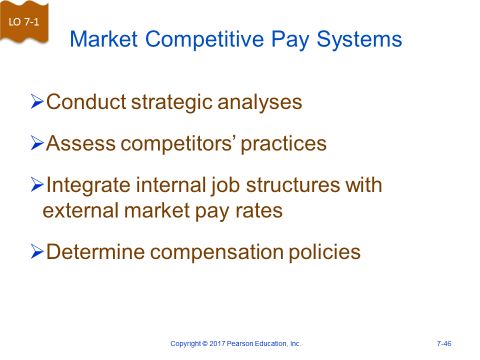
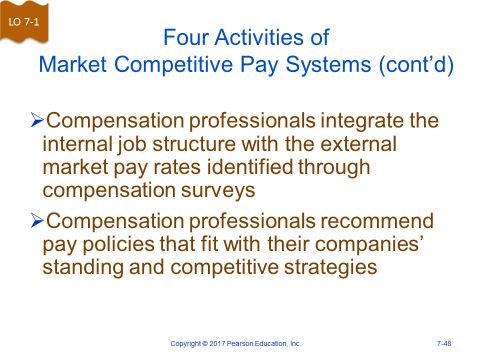
Establishing market competitive pay systems is a form of job evaluation, but this time we're moving beyond job content to look at external market pay rates. So what are market competitive pay systems? That's learning objective one, see slides 3 through 6. Well, market competitive pay systems refer to a company's compensation policy. It refers to the imperatives of competitive advantage and the key role in promoting recruitment and retention of talented employees. There are four steps that compensation professionals can undertake to develop market competitive pay systems, and some of these apply as well to other areas of human resources. So the first, conduct strategic analyses and this is something that we would hope that other areas of HR are looking at. We want to then assess competitors’ pay practices and with that information, integrate our internal job structures so what we looked at in the previous chapter, internal consistency, we want to integrate those with external market pay rates and then we want to conclude with a determination of compensation policies.
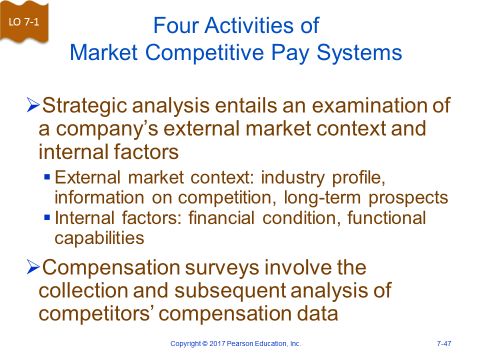
So now let's give some thought to, in a bit more detail, to these four activities. The first is strategic analysis. This is something that you should think about with regard to your company, your company as context. Also if you're interested in other companies, you can conduct some research through Google searches to help gather some of this information to give you a picture of a company's strategic position. Strategic analysis entails an examination of the companies’ external market contacts and internal factors. Examples of external context are industry profile, information on the competitors, long term industry prospects. We also consider internal factors such as the company's financial condition and its functional capabilities. That is if it's a manufacturing organization, does it have sufficiently highly skilled employees who can function appropriately in high tech manufacturing environment.
With regard to compensation surveys, we’re interested in collecting and analyzing competitors’ compensation data. Then we want to integrate the internal structure with the external market pay rates identified through compensation surveys and this will also require some analysis. And then compensation professionals recommend pay policies that fit with their companies standing and competitive strategies. Second learning objective focuses on compensation surveys. The information can be found on slides 7 through 28. We're devoting a substantial amount of time in the textbook and in the slides to compensation surveys because these represent the foundation of sound and effective market competitive pay systems.
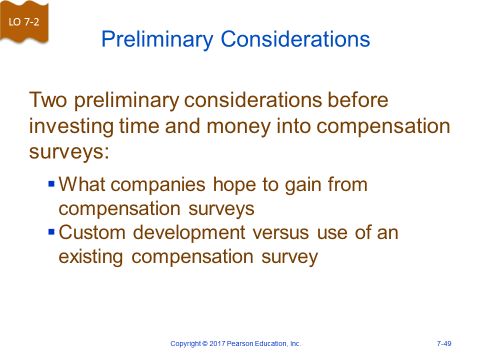
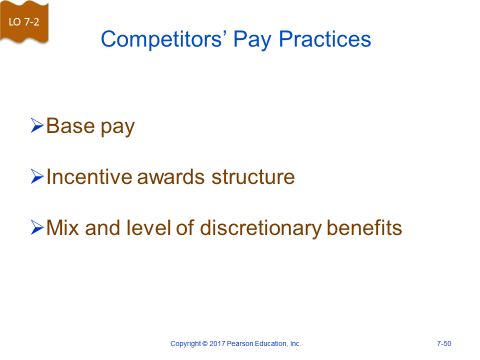
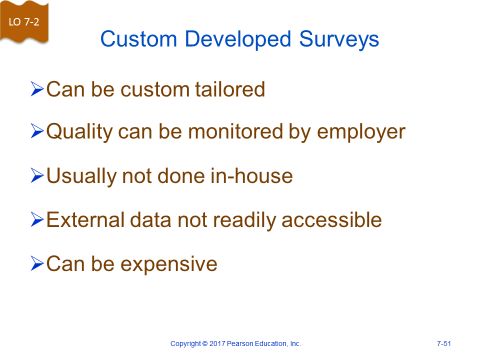
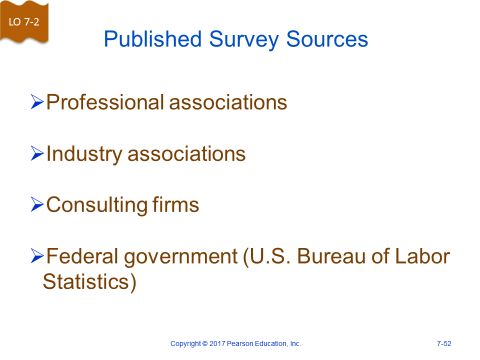
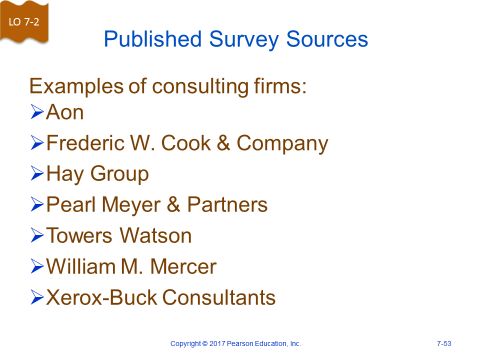
So to start off with this, we had one of the main considerations is whether we want to develop the survey ourselves or use an existing compensation survey. We also want to make decisions about what information we're interested in assessing. So typically we are looking to collect data on base pay, incentive award structure and the mix in level of discretionary employee benefits. To custom develop these surveys requires a great amount of expertise and usually this is not something you find within many companies. So you will see many companies going to external sources to obtain compensation survey data and what are some of the sources? We can look toward information from professional associations. Professional associations often have compensation survey data that they share with its member organizations and individual members of the organization. Members are more likely to provide information in anonymous surveys to their professional associations because they all have a common interest in understanding what the compensation pay rates and structures are in a particular profession. Companies are interested in learning this information to help them structure competitive pay rates to get and keep the best employees and individuals are interested in learning what the competitive pay rates are so that as they seek employment, they understand their market value. There are many different professional associations that we can find specialized in particular occupational groups, such as engineers and even more in particular, chemical engineers as an example, and in industry association whose members are companies. So for example there is the American iron and steel institute comprised of 31 member companies including integrated and electric furnace steel makers. You can go to industryweek.com to find a long list of associations, especially in the manufacturing industry. Consulting firms represent another source of compensation survey information. The textbook and slide 11 provide a list of consulting firms that specialize in compensation. These firms are very well-known and keep in mind that they are very expensive.
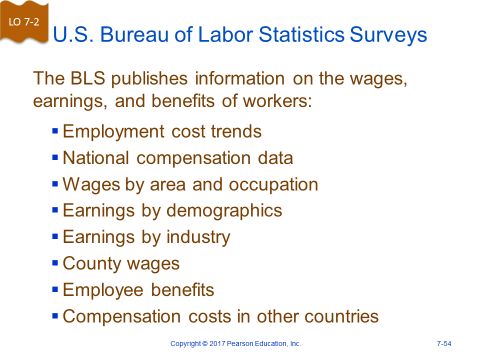
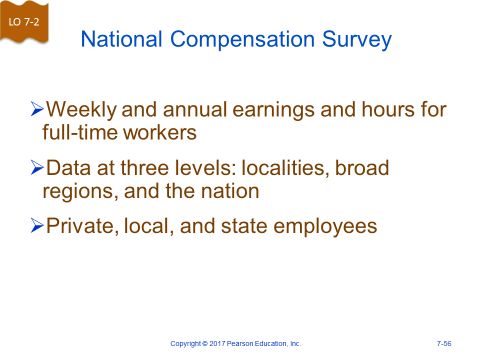
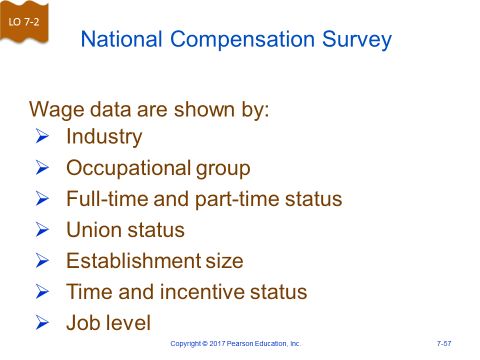
Typically, you find large corporations with the resources to purchase data and survey results from these consulting firms. Other companies with fewer resources and even large companies that choose not to pursue the services of consulting firms might rely on data that are free. And that is we can find a wealth of information about compensation practices in the U. S. bureau of labor statistics website. The federal government publishes all things regarding labor in its US bureau of labor statistics. You may recall from the statistics course, the data analysis project that I asked you to complete in groups. I provided data sets which I extracted from various U. S. bureau of labor statistics surveys. In the area of compensation, there is a wealth of data. There are data available for wages, earnings and employee benefits. You can find the surveys on the U. S. bureau of labor statistics website. Examples are employment cost trends, national compensation, survey data, wages by area and occupation earnings by demographics, industry, county, all kinds of information about the prevalence costs and types of employee benefits offered by companies. And there is some data unfortunately not as updated as I would like to see, on compensation costs in other countries. When you have time, you should go to the bureau of labor statistics website to review what is available, become familiar with it because you may find that those data are very useful. You'll find in those surveys summary tables and you will also, in many cases, be able to download the raw data from those sites at no cost. All of this described within each survey site in the bureau of labor statistics.
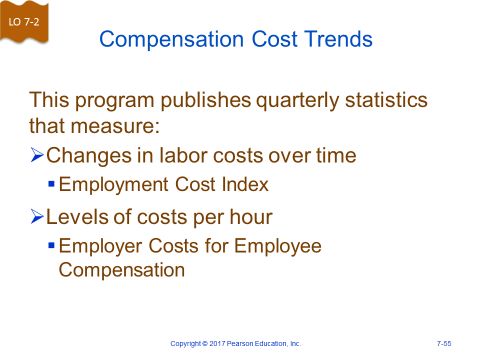
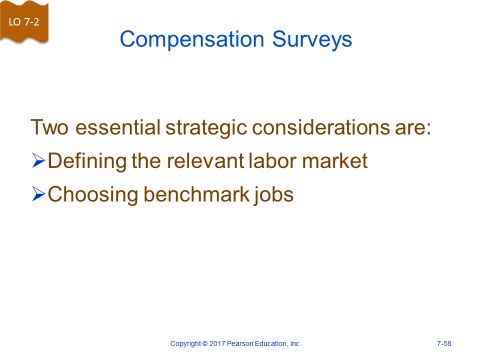
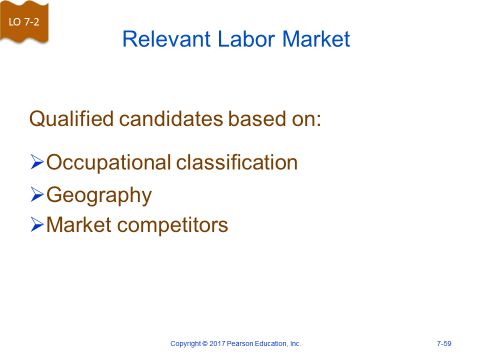
The textbook also provides a brief summary of each of the surveys that I mentioned. So for example the compensation cost trends survey publishes quarterly statistics that measure changes in labor costs over time such as the employment cost index. So what is the change in employment costs over a quarterly period of time? And you can also find levels of costs per hours for employee compensation. The best way to learn what these surveys have to offer is to immerse yourself in them rather than my describing them in this pre-recorded lecture and of course I'm always happy to answer your questions about them. As we select surveys we want to give consideration to the relevant labor market and benchmark jobs. Regarding the relevant labor market, we're referring to: where do you find the qualified candidates based on occupational classification, geography, and market competitors.
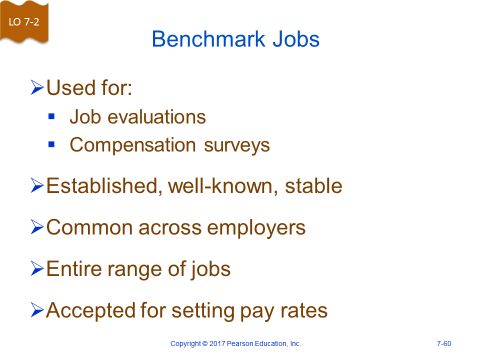
Benchmark jobs are used to help us link our internal job structures with external market pay rates. We're never going to find a job for job match between any one company's job structure and the external market. So we rely on these benchmark jobs as established, well-known and stable jobs that we find in the market that are typically common across employers that represent the entire range of jobs in different occupational groupings that we will accept for setting pay rates within our company. And even when we find benchmark jobs, we have to be very careful not to simply match those jobs with jobs within our company. Because there are likely to be subtle and even substantial differences in many cases between how we need to find a job within our company and how the benchmark jobs tend to be described in compensation surveys. So this requires going beyond job titles to looking at job descriptions.
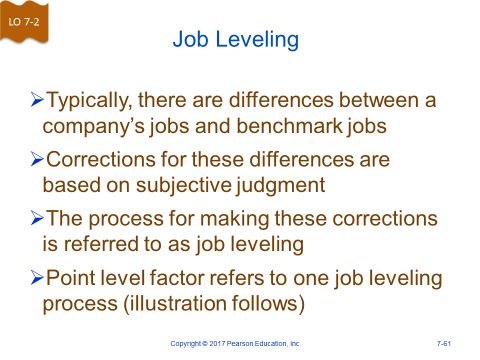
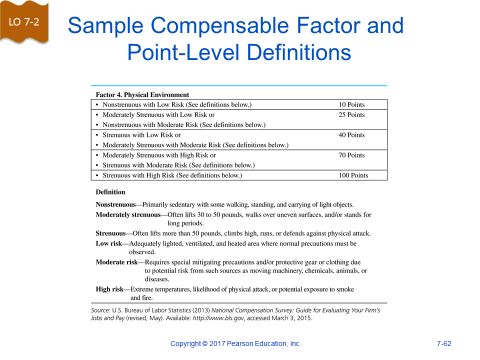
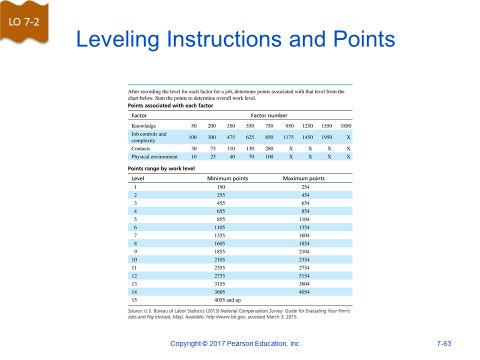
Now in surveys there should job description information and you have job description information in your company. With that information we need to engage in a process called job leveling. As I mentioned there are differences between a company's jobs and benchmark jobs. We need to make corrections for these differences and we rely on our judgment to do so. The process for making these corrections is referred to as job leveling and there is a specific type called point level factor job leveling. You can find the example of this on slide 20. The U. S. bureau of labor statistics provides an excellent resource that addresses job leveling in detail. You can find the reference for the source on slide 20 and in the textbook.
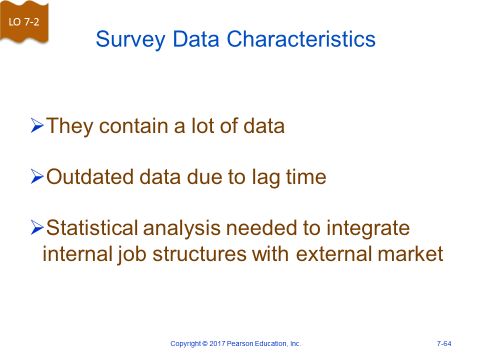
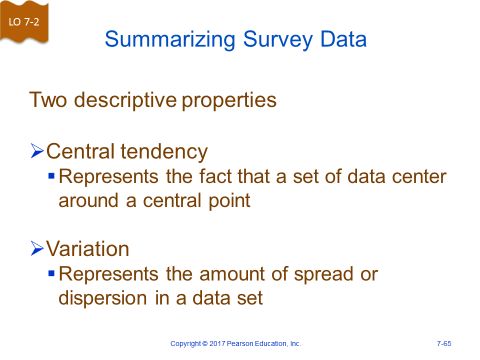
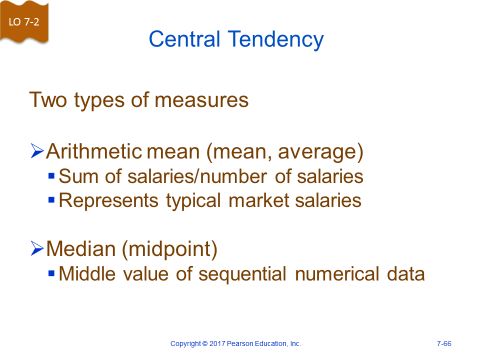
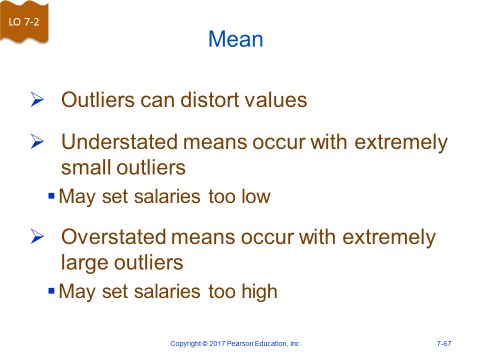
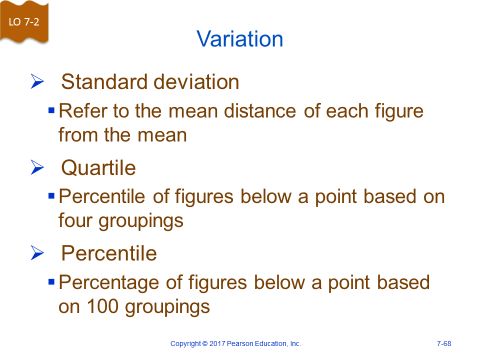
Not surprisingly, surveys contain a lot of data, so much data that eyeballing it provides no insights into what they mean. Also we have to keep in mind that when we obtain survey data it's already outdated. We are going to be interested and planning compensation for some future period and we’ll have to rely on some techniques to project ways to make the data relevant for future periods of time. All of this requires that we call on statistical analyses to make sense of these data and to make these adjustments. I won't describe them here but we start off with descriptive statistics and that helps us to summarize the survey data. As you know from the statistics class we can talk about two descriptive properties of data, central tendency and variation. You can look at slides 23 through 27 up to refresh your memory of these descriptive statistics. The textbook also provides information on these measures. As I mentioned a few moments ago salary survey data are old, they’re historical data once we get our hands on them. And compensation professionals are planning for a future period of time. So we are interested in ensuring that our pay rates are not only current at the beginning of the plan year, but also over the course of the plan year. And by the way compensation professionals usually establish compensation plans for a one-year period.
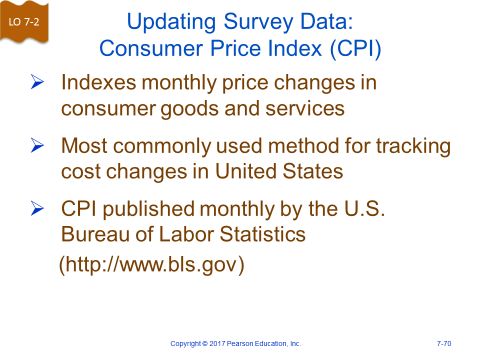
So on slide 28, There is brief review of the consumer price index, the CPI. The U. S. bureau of labor statistics publishes the CPI which is an index of the cost change in goods and services over time. For the entire United States as well as for regions within the United States. Please look at the textbook for brief descriptions of the CPI and their calculations that help you to understand how we can update our salary survey data to project relevance between the start and end of our compensation plan. As always if you have questions I'll be glad to answer them. The consumer price index helps us to make these adjustments. Our interest with it is to consider inflation. Over time we see that the cost of goods and services increase and we want compensation to have the same purchasing power over time. But the CPI is not the only basis for determining adjustments to salary survey data. For example, I was reading an article in the Wall Street Journal that talked about how law firms usually agree to a starting pay rate for first year law associates. For some period of time it was $160,000. Now law firms are considering increasing that amount $180,000. So information from sources other than the consumer price index, can help compensation professionals make adjustments or future pay rates in order to be competitive. I should note that I said that law firms agree to a starting pay rate and that's not exactly true and in fact that might be a form of collusion. Rather, a law firm might decide to increase the rate for a variety of reasons and other law firms can choose to follow and in many cases law firms will do this in order to be competitive.
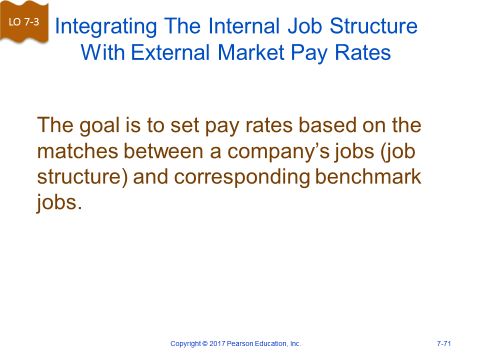
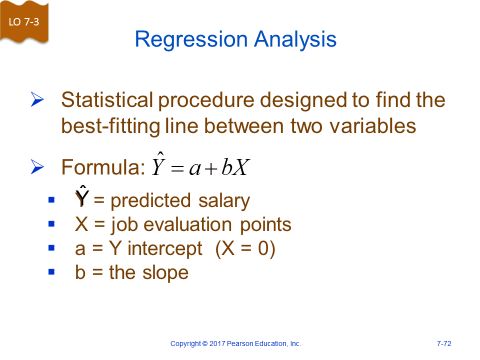
Now that we have collected our compensation survey data and we've been able to describe it and update it, it's now time to move toward integrating our internal job structure, based on the job evaluation process with these external market pay rates. So our goal is to set pay rates based on the matches between a company's job structure and corresponding benchmark jobs in the external market. This is learning objectives 3 and slides 29 through 33 contain the information. Descriptive statistics usually focus on one variable. So average pay rate in the engineering profession. So one variable, pay rate. Now that we move on to integration, we are introducing the analysis of multiple variables simultaneously. And we rely on regression analysis techniques to do this. As you know, regression analysis is the statistical procedure designed to find the best fitting line between two variables.
Slide 30shows us the basic formula for simple linear regression, that is one independent variable. You can see here what the variables are. We are trying to predict salary based on all kinds of compensation survey data that we've collected. And we predict salary based on job evaluation points. Two other elements of regression equations are the Y intercept, that is the value of Y when x equals 0. In this case when we don’t have a job that's being captured. No job is worth 0 points. And the slope, which is the pitch of the regression line.
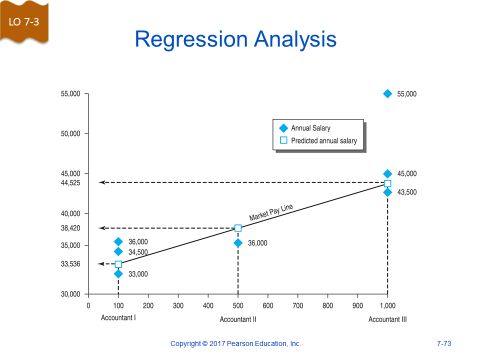
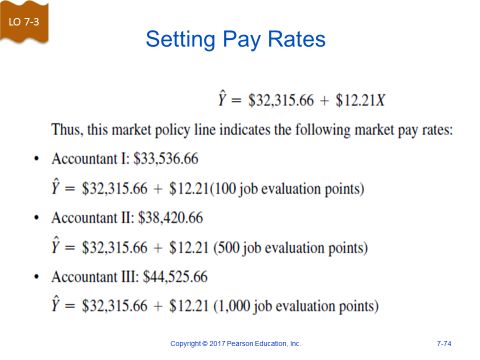
Slides 31 and 32 give an illustration of the result of a regression analysis. You could see that for a hypothetical structure involving accounting jobs, so the horizontal axis, and those numbers are job evaluation points. And the Y axis or vertical axis shows the market pay rates. And that regression analysis allows us to summarize the correspondence between our internal job structure, so the variation in job evaluation points with the variation and market pay rates for benchmark jobs. The market pay line is the regression equation that comes from the analysis. And we can predict or say that the typical pay rate for a job in this example of 500 points, is approximately $38,000. We can look at like 32 to compute various values to determine what the typical pay rate should be for a job in our company based on its job evaluation points.
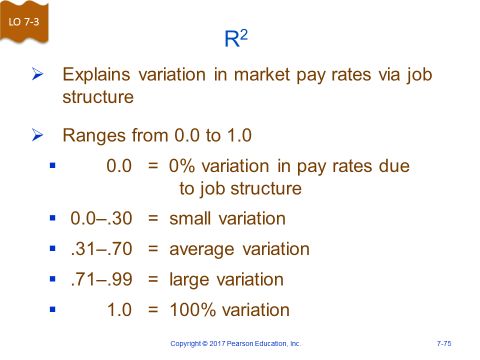
In the statistics course we also studied the r^2 statistic which goes along with regression analysis. As you may remember as well r^2 explains the variation and market pay rates via job structure. So let me back that up, that's the application here. But we are trying to explain the variation in the Y variable based on variation in the X variable. So our Y variable, market pay. Our X variable, job evaluation points. R^2 ranges from 0 to +1, where 0 means that 0 variation and pay rates can be explained by job structure. A value of 1 indicates that entire variation and market pay rates can be explained by our job structure. And then we could see values in between. I've indicated some ranges here and given them labels. So for example 0 to 3.30 for our square represents small variation. These are conventional interpretations. We don't want to spend time trying to say that there is a big difference between an r^2 of .36 an r^2 of .38, so we bracket them up into convenient ranges. The goal in our analysis is to achieve anr^2 that's as high as possible. If you can find something that's at least 0.7, then you've done a good job. We want r^2 to be as high as possible because we are planning to set our pay rates and pay ranges and reference to the marketplace. If r^2 is low, then we're not finding a very good correspondence between how we value jobs and how the market is valuing jobs. Often times, a low r^2 can be the result of poor selection in benchmark jobs and connecting them with our jobs internally.
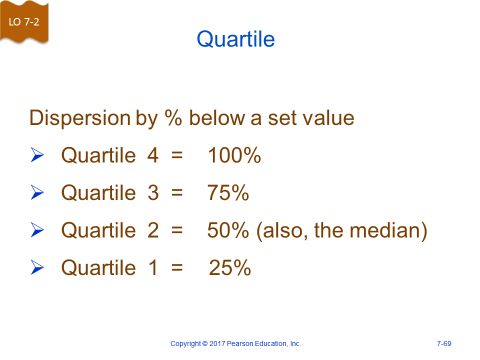
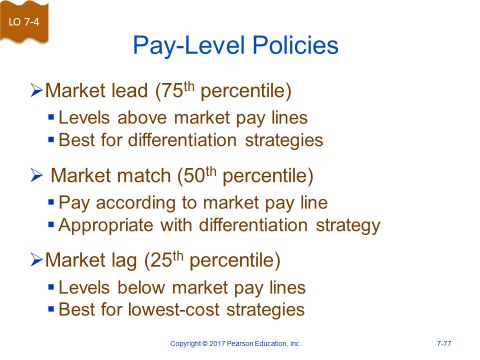
Learning objective four, addresses compensation policies and strategic mandates. This information can be found on slides 34 through 37. Compensation policies are broken down into two subsets. The first, pay level policies. And the second, pay mix policies. Pay level policies are usually described in one of three ways. We can have a market lead policy, a match, or lag policy. We have to quantify what we mean by those labels and in compensation typically market lead policies are referenced at the 75th percentile. That means that on average 75% of the salary survey rates are below the rate that you are setting in your company. Or you could say that you are in the top 25% of pay. Companies have to make choices based on how critical jobs are to the company, based on supply and demand when determining what the pay level policies should be. This is useful information but when we move to recognizing employee contributions, we’ll be expanding on pay level policies by building pay ranges.
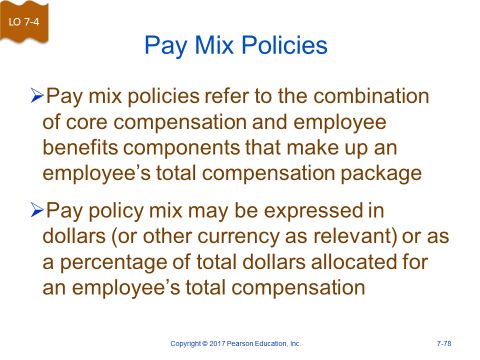
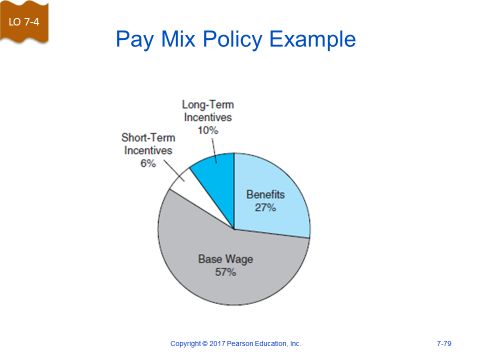
Pay mixed policies, and you could see an example on slide 37, tells us that for every dollar that we spend to compensate an employee, and here I'm referring to total compensation, benefits, wages and the different ways that we can reward employees such as base pay and incentive pay. So for every dollar we spend, what percentage of that is going to these various components. Note that the benefits expenditure is approximately 27%. That's a fairly typical number. If you were to go to the employer costs for employee compensation survey on the U. S. bureau of labor statistics website, you will see that typically companies are spending around 30% of their compensation dollars to provide employee benefits. When we get to employee benefits later in the course we will talk about some of the breakdown in costs of various benefits components. But overall the amount is roughly 30%. To be competitive, companies will usually start off by matching the typical benefits expenditure on a per employee per hour worked basis. Then, in allocating the remaining amount of money, it’s important for compensation professionals to go back to the job description and look at the expectations that are being set for the employee and how can we motivate them to excel. So when we talked about seniority pay for example, that has the potential to lead to employee complacency because as long as they're providing a performance at some reasonable level, they will get a pay increase just because they've been there over time. Merit pay requires employees to perform and so does incentive pay. We might consider incentive pay when we can measure job performance objectively or some part of it objectively. We can find the mix perhaps between merit pay that will sit well with subjective measures and incentive pay for objective performance measures.
I should mention that when we discuss pay level policies and pay mixed policies, we are likely to have more than one set of these within a company. And oftentimes we will find these paired and attached to different job structures. As you've read about, we create jobs structures for similar types of jobs, for example accounting or engineering where we can see a progression in the degree of fundamental compensable factors across jobs. And based on those differences and job duties and expectations, we're likely to see differences and what is needed to attract and retain employees, so thinking about pay level, and the mix of pay in order to help motivate them and direct them toward excellence. Well this concludes the pre-recorded session for internal consistency, that leads to job structures and market competitiveness. In the next pre-recorded session, we will talk about structures that help us to recognize employee contributions. We will build upon everything that we talked about in this pre-recorded session to build those structures.