Welcome to our lecture on human resource and planning. Each RP as is often known is the processes and activities that we undertake to help forecast the demand within an organization and the availabilities of labor within an organization.
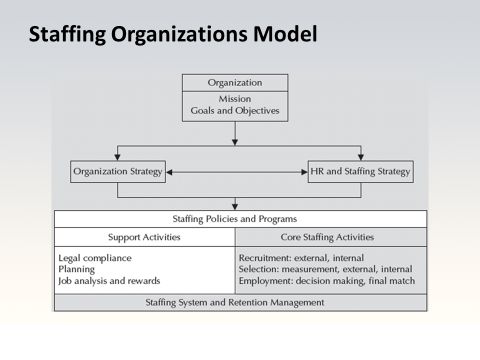
Within the staffing organizations model planning is another support activity just like legal compliance which we've already reviewed. So planning legal compliance and then job analysis and rewards, which we'll soon cover, all fit in the support activities that are going to enable us to be most effective when we look at the course staffing activities in just a little while.
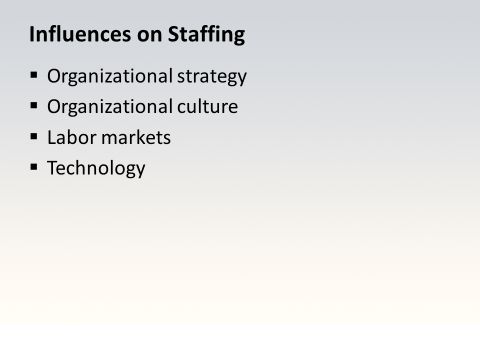
Influences on staffing could come from within and outside the organization. Many of these influences determine to some degree the quantity and quality of staffing in organizations. Especially if the organization is not being strategic and proactive. in dealing with the internal and external influences. One way that the organization is proactive though is with their strategy. So organizational strategy influences staffing by setting out goals, quantity and quality decisions, financial marketing goals are whom and how the organization is staffed. Organizational culture is often something we think, oh that's often something internal as well and indeed, you know many organizations internally try to determine their culture but there's also this idea that culture is a product of the people, the people make the place. That's why Ben Schneider is famous for developing using industrial organizational psychology scholar and he addressed the Society of Industrial Organizational Psychology as president of the organization in 1987 and his address was all about the idea that the people make the place and this happens because organizations attract certain kinds of people and then individuals select themselves into organizations that kind of match the values and therefore the culture that they might seek in an organization. And then individuals attrite, so they leave the organization if it doesn't ultimately fit their values, if the culture doesn't match up with their values. So this model again also known as ASA, attraction selection attrition, so they would say well look, culture is kind of a difficult thing to understand causally where it comes from, it's coming from the people and so even though an organization might attempt to define its own culture it's likely simply because of the attraction selection attrition of individuals within the organization. Culture, you know the might be various degrees of hierarchy in bureaucracy, different styles of communication that different organizations are known for and this is certainly going to influence who might want to join the firm. Labor markets is something that our course on labor economics will expand on, but we're certainly going to touch on it in this lecture. This getting at the labor demand and supply. Thinking about shortages and surpluses that might occur. We can look at different types of employment relationships and different ways that labor demand and labor supply might change depending on whether we're looking at traditional employee relationships or alternative working arrangements such as independent contracting or hiring temporary workers through a staffing firm. Finally, we can think about how technology influences staffing. So technology can eliminate jobs for example shoemakers; cobblers use to be a much larger industry than it is today because shoes were, in the past, not mass produced as they are today. They were often made on site even, to your specific foot. So that was an industry that technology has largely allowed to be shifted to kind of mass production. There's many examples of that. So at the same time technology can create new jobs or expand the labor demand for specific types of jobs such as computer programmers. And you can also change skill requirements so in a nation like the United States STEM jobs are increasing. So STEM stands for science technology engineering mathematics and so the jobs that kind of fit within the purview of the skill sets are increasingly different. So these are just some of the ways you think about influences on staffing and you might want to consider other influences yourself and you can certainly look in the book force more examples.
I Encourage you to look at exhibit 3.2 in your book for more information on internal versus external staffing and kind of the advantages and disadvantages of both. So you know, I have a question here- what are the advantages and disadvantages? You might pause this for a moment and try to write some down so you can remember them and then restart this. So to review some advantages of internal staffing would be that it's relatively quick and cheap compared to external hiring. So you have information on employees, they're already in the organization. Lot of the on boarding requirements have already been taken care of these employees. And so it's a lot quicker too kind of get them shifted into a new job. Employees often react well to internal staffing because they see it as that the internal job ladders that are available to them, the opportunities for advancement within their organization. Now disadvantages are that you not really getting new knowledge, skills, ability, other when you keep the same people in your organization. So if you already have highly skilled individuals, that's great, but even in the case of highly skilled individual, sometimes want new perspectives and you're not going to necessarily obtain that if you choose to hire internally and promote internally. There's also a relatively small labor market right? Even for a large organization if you're only looking inside, you're just looking at a fraction of the possible workforce you could hire for getting the job. And then finally you can perpetuate under representation. So if diversity goals are not being met and you find that you're under-representing protected classes in your organization, then you might want to think about, alright we need to look outside our microcosm of the organization. When it comes external staffing, some of these advantages and disadvantages are direct trade-offs from internal staffing and so advantages include that you have a much larger labor market now and this is both for diverse candidates as well as knowledge, skills, abilities, other, right? You have the opportunity at least to hire highly skilled individuals and individuals with unique skills and perspectives from what is inside your organization. Disadvantages, that is more time consuming, it can be expensive and it could also be more risky. So as a general rule external hires are going to be more likely to exit then internal hires. By definition, if internal hires have persisted for a while, we are you know they're not going to be quick to exit and to some degree the longer someone stays with the firm the more likely they'll continue to stay with a firm. So the external labor market is a bit more risky, right you might pull in someone who is it a great fit and very skilled but never the less they find this isn't where I want to be and they leave your organization.
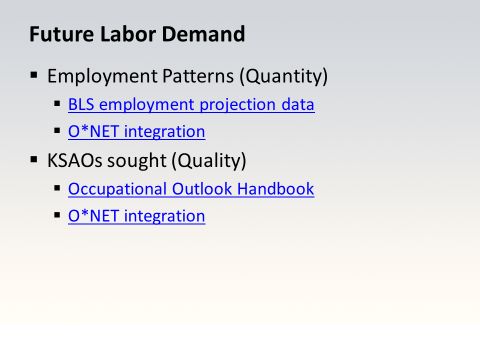
So I'd like you to spend a little bit of time on this page as we talk about future labor demand. And click through some the links that should either be in the slides or in the notes or transcript for these slides. So the first couple weeks we have are four employment patterns and this is getting at the quantity of demands, how many people are going to likely be available in external labor markets. The first place to go for this is the bureau of labor statistics BLS employment projection database. And so this will show a forecasted, currently it should be through the year 2024 and they continue to push out how forward looking they are and they will look at various occupations, occupational groupings and various locations and provide data on the forecasted demand for workers, so how much growth do they predict will occur in given industries. The occupational information network, onet. Onet online also integrates information from the bureau labor statistics and they have what they call bright outlook jobs which are jobs that basically kind of pass a certain threshold for projected growth and so they highlight jobs that are expected to grow. If you want a quick summary at a national level, jobs that are likely to grow you can look at Onet, so Onet with integration with employment patterns. Now we're also interested in the quality of employees okay so the quality of employees we're getting at that knowledge, skills, abilities and other characteristics that organizations seek in individuals. So organizations might not need more individuals but they might need individuals that are more qualified. So for this we can look at the occupational outlook handbook, also provided through the bureau labor statistics and there's a link there to it and this provides projected number of new jobs and growth rates for jobs. And it includes the break down of entry level education, on the job training, and median pay for jobs. So we can start to look at, what are some of the specialized training and levels of education that are required for jobs, we can look at the future projections for these different KSAO related variables. Onet also integrates KSAO's sought in that you can look at jobs at that have bright outlook and then click through to find all the categories of knowledge, skills, abilities for each of these jobs. So you click on the link for onet integration there and I think it takes you to an example for human resources managers and so you can look at folks who are in jobs that you yourself might be in or be aspiring to and you can look at, what are the knowledge, skills, and abilities that onet has identified to these jobs and onet really does represent a large and sophisticated data collection where they talked many job incumbents and did a thorough kind nation level survey of occupations to get the data that's there so it's a great place to start if you want to know what jobs are kind of growing and what are the knowledge, skills, abilities, and other characteristics demanded by these jobs.
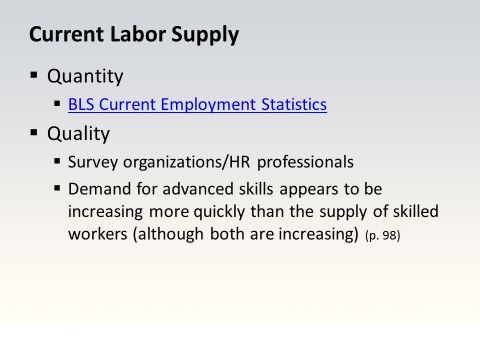
Now we're also interested in our current labor supply. For this we can look at, as far as nation level data, at the bureau of labor statistics current employment statistics. You can look up currently as far as the best data we have, show what would be the quantity of individuals in various jobs in various regions. We also look at quality through surveys of organizations and HR professionals. Your book points out certain findings from surveys of HR professionals. Among other things they point out the demand for advanced skills appears to be increasing more quickly in the supply of skilled workers but notably both are increasing. In other words, it's not quite as dismal as you might think. It's not that people are kind decreasing in their skills it's just that the demand for skills is increasing more quickly than the skills of workers.
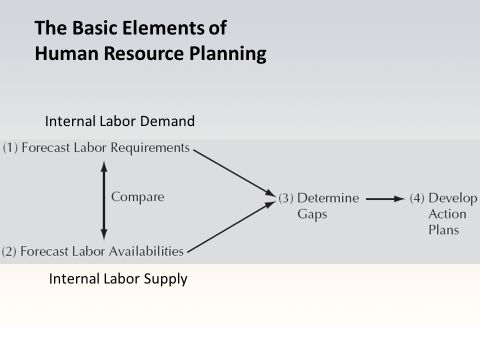
So as we get into a human resource planning specifically we kind of talked about some of the influences, we still think about labor supply and demand at least at the national level but out once we kind of dive in here, what's going on with HR planning and this gets back to the definition I covered at the start of the lecture, is we're going to look internal labor demand compared to internal labor supply. And so that's looking at the forecast, so future labor requirements and comparing it to forecasted future labor availabilities. We'll then say, do gaps exist and how large are they? Do they represent a surplus ar a shortage? And then depending on the gaps we can develop action plans. Try to close these gaps. I would like to note as well this point, a term in the text that we will be using FTE's. FTE's stand for full time equivalents so we use this often when we're getting into the quantitative head count of employees. And what this is getting at is you know we might have part time and full time employees and we want a common metric to talk about them together so how do we do that, well say we have a 40-hour work week and that's considered full time then our time employees will simply be multiplied by the percentage of time that they work. So if they work half time, they work 20 hours then we would just multiply them by 0.5 right, that's 50% of the full time employee. So we use the resulting numbers to set out how many employees do we actually need hired, both accounting for full time and part time employees together.
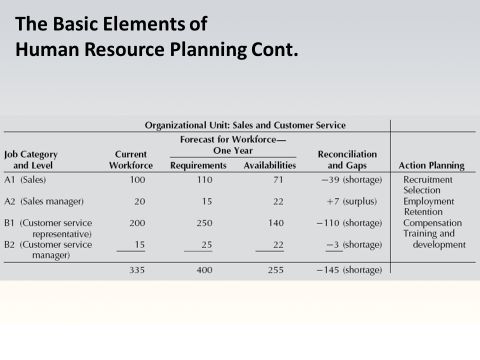
So what might the four components of HR planning look like in practice? Well by this table which we'll revisit, gives a nice example these four things. So we're comparing the requirements and availabilities so that's again the future forecasts of requirements and availabilities for different jobs. So you can see these job categories and their different levels. And we're looking at gaps. So you can see for example the first level for sales A1 sales shows that one year from now we are estimating we will need 110 workers but then we'll only have 71 so there's a shortage of 39 employees. So then we go to a kind of fourth step and think about the different types of actions, plan for these different actions to try to close this gap. So that's high level what we're going to do. We'll dive into where each of these numbers come from and viable action planning options that we.